Why Mystery Works
Blind boxes didn’t become popular by accident
Nobody didn’t take blind boxes seriously at first. When they started showing up outside of toys and collectibles, they felt like a novelty brands would play with for a quarter or two before moving on. Something you’d see during a slow sales month or a campaign brainstorm that ran out of better ideas. A gimmick, basically.
But then they didn’t go away.
They kept resurfacing. In beauty. In fashion. In streetwear. In places where randomness should have felt risky or even brand-damaging. Instead of disappearing, the format matured. It got cleaner. More intentional. More common. And at some point it became obvious that blind boxes weren’t just a tactic.
They were a response. Not to competition. Not to algorithms. But to how online shopping feels now. E-commerce didn’t break because it stopped working. It broke because it stopped feeling like anything.
When optimization drains the life out of shopping
For the last decade, e-commerce optimization followed a single guiding principle: remove friction. Show more information. Reduce uncertainty. Answer objections before they’re asked. Make the path to purchase shorter, clearer, and faster. And from a performance standpoint, that approach delivered. Conversion rates improved. Funnels tightened. UX got cleaner.
But something else happened along the way. Shopping became procedural.
Every store began to look the same. Product pages blurred together. Discounts followed predictable cycles. Bundles became transparent. Reviews became noise. The emotional side of buying — curiosity, excitement, discovery — slowly got engineered out of the process.
Consumers adapted quickly. They learned how sales work. They learned when to wait. They learned how to compare everything in seconds. And once people understand the system, it stops surprising them.
Blind boxes reintroduce surprise by design. They don’t try to out-optimize the standard product page. They step around it entirely. Instead of promising certainty, they offer anticipation. Instead of clarity, they offer a moment that hasn’t happened yet.
That shift is the entire point.
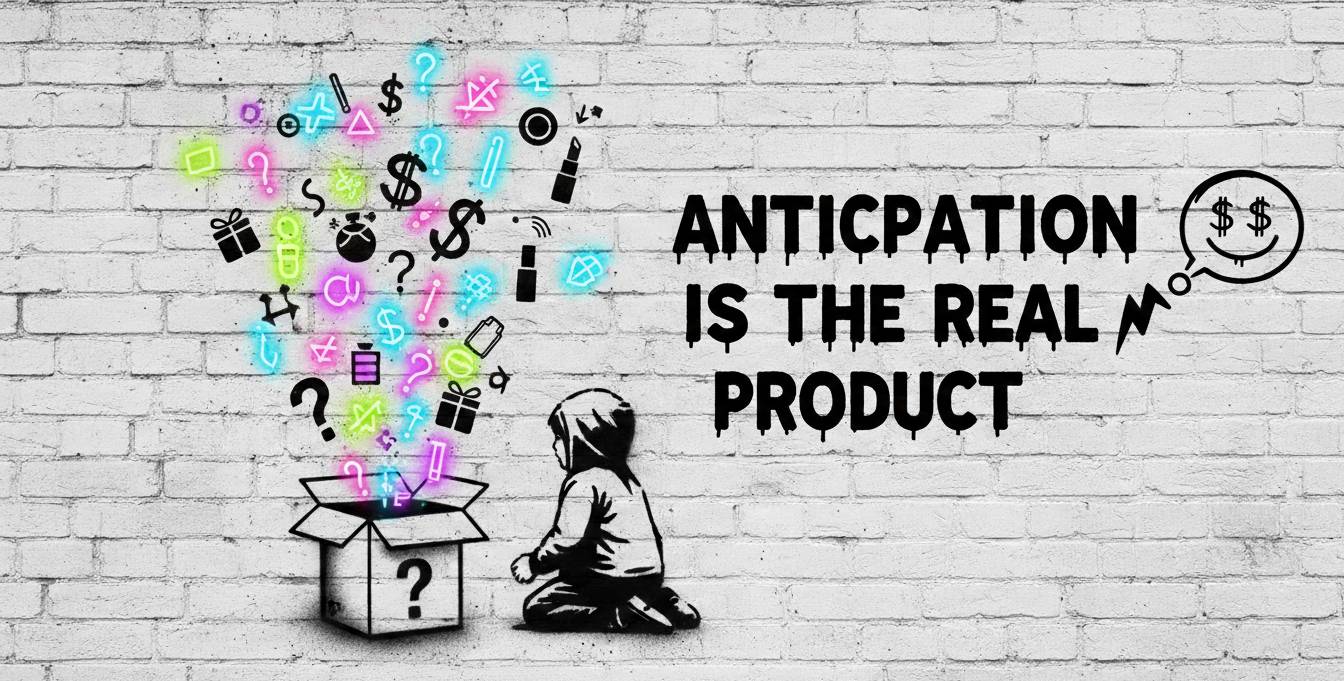
Anticipation is the real product
The thing most people misunderstand about blind boxes is that the product isn’t what’s inside the box. The product is the time between buying it and opening it. A normal purchase peaks at checkout. After that, the experience is basically over. You wait for delivery, you open the package, and that’s it. The emotional arc is short and flat.
A blind box stretches that arc.
You buy it. Then you think about it. You imagine what might be inside. You feel a low-grade curiosity that lingers for days. When it arrives, the opening actually matters. Sometimes you open it slowly. Sometimes you record it. Sometimes you react out loud. Sometimes you’re surprised by liking something you never would have chosen yourself.
That sequence is sticky.
People are wired to enjoy anticipation more than certainty. It’s why trailers work. It’s why cliffhangers exist. It’s why unboxing videos get watched even by people who never plan to buy the product. The buildup creates emotional engagement that certainty never does.
Blind boxes package that feeling and sell it.
Why beauty brands made the first serious move
Beauty didn’t adopt blind boxes because it was trendy. It adopted them because the category already lived in the emotional part of the brain. Makeup and skincare aren’t purely functional purchases. People buy how they want to feel, how they want to look, how they want to see themselves. Discovery is part of the culture. Trying something new is the reward, not the risk.
When a beauty brand launches a mystery box, customers aren’t thinking, “I hope I don’t get something useless.” They’re thinking, “I trust this brand’s taste.” That trust changes the entire equation. Uncertainty becomes permission.
Permission to experiment without overthinking. Permission to receive something unexpected. Permission to enjoy the reveal without optimizing every choice. And once customers have a good experience, what sticks isn’t the individual products. It’s the feeling of being pleasantly surprised.
That’s why mystery works so well as a repeat mechanic in beauty. People don’t remember every shade or serum. They remember how the box made them feel when they opened it.
That emotional memory drives the next purchase more than any ingredient list ever could.

Fashion used mystery to escape the discount spiral
Fashion’s relationship with blind boxes is less emotional and more strategic. Inventory cycles are unforgiving. Trends shift. Demand forecasts miss. Suddenly you’re sitting on product that isn’t bad, it’s just late. Discounting clears shelves, but it quietly trains customers to wait and devalues everything you sell at full price.
Blind boxes offered an alternative path.
Instead of saying, “This didn’t sell,” brands could say, “This is part of a curated experience.” The product no longer had to justify itself in isolation. It could exist inside a story. Streetwear culture made this obvious. That entire ecosystem runs on anticipation, scarcity, and shared moments. Drops aren’t convenient. They’re intentionally dramatic. Adding mystery didn’t feel risky — it felt native.
Not knowing which version you’ll receive doesn’t frustrate that audience. It excites them. The reveal becomes the moment that matters. The product becomes content.
That’s a fundamentally different relationship between brand and buyer.
Luxury didn’t reject mystery — it reframed it
Luxury brands approached blind boxes carefully, and for good reason. Luxury is built on control. On precision. On knowing exactly what you’re getting and why it costs what it costs. Randomness, done poorly, cheapens that instantly.
But consumer expectations shifted.
Younger buyers care less about perfection and more about experience. They value access, storytelling, and moments that feel limited or insider-only. Mystery worked when it was framed as curation rather than chance. Not “you get what you get,” but “we chose this for you.”
That distinction is critical. When blind boxes succeed in luxury, it’s because the uncertainty isn’t about quality. It’s about discovery. Archive pieces. Insider selections. Limited windows. Mystery becomes a signal of confidence, not chaos.
Social media changed the stakes completely
Blind boxes would not be what they are today without social media. Unboxing content thrives because it’s inherently watchable. There's tension. There's curiosity. There's a reveal. You don’t need context. You don’t need expertise. You just want to see what happens.
That simplicity is powerful.
Every blind box opened is potential distribution. Sometimes it’s intentional. Sometimes it’s spontaneous. Either way, the customer becomes the ad. And unlike polished brand content, reactions feel real. This also means brands don’t control the narrative anymore.
Mystery formats magnify both outcomes. That’s why they’re dangerous when handled casually and incredibly effective when handled well.

Why blind boxes actually make Financial Sense
From the outside, blind boxes can look reckless. You’re giving up control. You’re not showcasing specific SKUs. You’re relying on trust.
But when you look closer, the economics are solid.
Blind boxes increase average order value because customers are willing to spend more when the purchase feels experiential instead of transactional. They smooth inventory by absorbing slower items invisibly. They drive repeat purchases because curiosity resets after every good experience.
Most importantly, they reduce dependence on constant discounting. Instead of competing on price, brands compete on feeling. And feeling is harder to copy than a coupon.
Where brands usually get this wrong
The failure mode is almost always the same. A brand treats mystery as permission to lower standards.
They hide weak products inside a box and assume uncertainty will protect them. It doesn’t. Customers are forgiving of surprise, but they’re ruthless about feeling tricked. When a blind box feels lazy or cynical, the backlash is fast and public. Successful mystery formats are conservative where it matters. They guarantee value. They anchor the experience with something strong. They communicate expectations clearly without spoiling the reveal.
Mystery works best when it has boundaries.
Presentation matters too. Packaging, language, and framing determine whether the experience feels thoughtful or sloppy. A blind box should feel like a creative decision, not a logistical shortcut.
Technology turned mystery into a system
This trend didn’t scale until the infrastructure caught up. E-commerce platforms made limited drops easy. Subscriptions turned surprise into habit. Social commerce blurred the line between entertainment and shopping. Live streams added real-time suspense.
Brands can now test mystery formats in small runs, learn quickly, and adjust. That feedback loop is why blind boxes haven’t burned out. They’re evolving alongside the audience.
Why this isn’t a passing trend
Blind boxes aren’t working because they’re clever. They’re working because they fix something e-commerce broke. Online shopping became efficient, but emotionally empty. Mystery brings feeling back into the transaction. It gives people a reason to pause, to anticipate, to react. Not every brand should sell blind boxes. But every brand should understand why they work.
The brands winning with blind boxes aren’t chasing a trick. They’re responding to how people actually behave online. They’re building moments instead of funnels.
And that’s why blind boxes aren’t going away. They don’t just sell products. They make shopping feel human again.