DTC Was a Phase
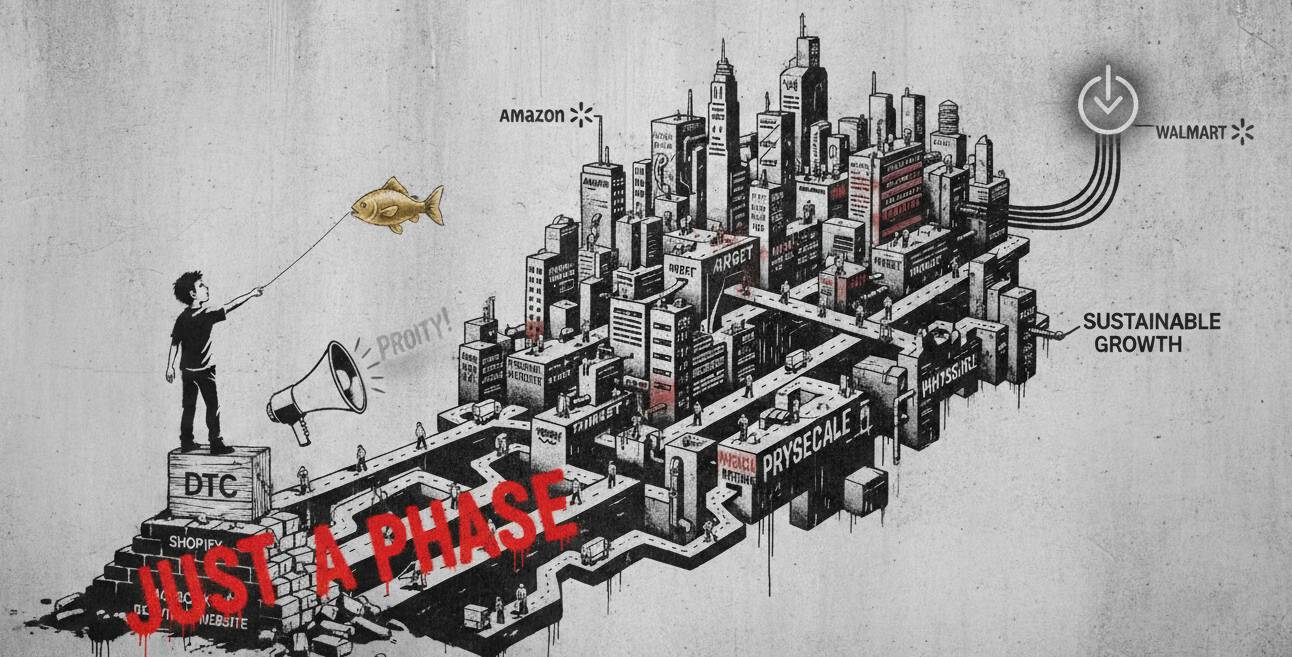
For years, saying you were a “DTC brand” felt like saying you were building the future. It implied you were smarter than legacy retail. Closer to your customers. More modern. More efficient. You didn’t need department stores. You didn’t need distributors. You didn’t need anyone between you and the buyer. You had Shopify. You had Facebook ads. You had a beautiful website and a strong point of view.
And for a while, that was enough.
But here’s the uncomfortable reality: for most brands, staying purely DTC today isn’t brave. It’s limiting. The market changed. The platforms changed. Customer behavior never changed as much as we thought it did. And now a lot of DTC brands are quietly discovering something they don’t want to admit out loud: Distribution matters more than purity.
DTC was born in a perfect storm
To understand why this shift is happening, you have to go back to why DTC worked so well in the first place. In the early 2010s, attention on social platforms was cheap. Facebook’s ad system was incredibly powerful. You could target specific demographics, interests, behaviors, and retarget them with surgical precision. Attribution was clean. Scaling felt almost mechanical. If you had a halfway decent product and compelling creative, you could acquire customers at a cost that left plenty of margin to reinvest.
At the same time, ecommerce infrastructure became dramatically easier. Shopify removed technical friction. Payment processing was seamless. Logistics providers scaled. You didn’t need a retail buyer to say yes. You didn’t need shelf space. You just needed clicks. That environment created a generation of brands that grew up believing retail was optional. It wasn’t optional. It was temporarily replaceable. And that distinction matters.
Cutting out the middleman didn’t remove the work
The DTC narrative was simple: retailers take a huge cut. Remove them and keep the margin. On paper, that sounds logical. But retailers don’t just “take margin.” They perform functions.
When you remove a retailer, you inherit those responsibilities. Instead of paying a wholesale discount, you pay Meta. You pay Google. You pay creators. You pay fulfillment providers. You build a customer service team. You absorb return costs. The middleman didn’t disappear. The cost center moved. And as customer acquisition costs rose, that cost center got heavier.
The CAC era is over
The single biggest reason most DTC brands shouldn’t be DTC anymore is simple: customer acquisition isn’t cheap or predictable like it used to be. The Facebook arbitrage days are gone. Competition intensified. Creative fatigue accelerated. Then Apple’s privacy changes made targeting and attribution weaker. Brands that once scaled confidently found themselves guessing. ROAS became unstable. CAC climbed. Margins thinned.
If your entire growth engine depends on buying attention from one or two platforms, you are fragile. And fragility is expensive. Meanwhile, customers didn’t stop buying. They just kept buying where it felt easiest. Customers don’t care if you’re DTC. They care about convenience. If they discover you on TikTok, they might search your name on Amazon before buying. Not because they don’t trust you. But because they trust the platform.
They want fast shipping. They want easy returns. They want reviews. They want to compare prices. They optimize for effort, not brand ideology. If you’re not present where they naturally transact, you create friction. And friction quietly kills conversion. Many founders resist Amazon or wholesale because it feels like “losing control.” But control without distribution is just isolation.

Gross margin is not the same as real profit
A lot of DTC brands proudly cite high gross margins. Seventy percent. Eighty percent. But gross margin doesn’t pay the bills. Contribution margin does. Once you layer in paid acquisition, creative production, influencer partnerships, shipping, returns, customer support, and discounts, that beautiful margin shrinks quickly. Wholesale margins look smaller at first glance. Marketplace fees feel painful. But those channels often come with built-in demand. You’re not paying to create every single customer from scratch. Sometimes a slightly lower gross margin with lower acquisition costs produces a healthier business.
DTC math looked incredible when traffic was cheap. When traffic got expensive, the illusion cracked.
Marketplaces are infrastructure, not the enemy
There’s a tendency among DTC founders to treat Amazon like a villain. Like listing there somehow cheapens the brand. But marketplaces are infrastructure. They aggregate demand at an enormous scale. When someone types “best protein powder” into Amazon, that’s high-intent traffic. That’s not interruption. That’s desire.
Why would you opt out of that?
Yes, you compete more directly. Yes, pricing is transparent. Yes, reviews matter. But avoiding platforms doesn’t protect your brand. It limits your reach. You can’t scale if you’re allergic to where people shop.
Retail isn’t dead. It’s evolved
Another myth the DTC era pushed was that physical retail was dying. It wasn’t dying. It was adjusting. After the pandemic surge in ecommerce, physical retail rebounded. Consumers returned to stores. Omnichannel became normal. People blend online and offline fluidly. Retail does something digital alone struggles to do: it legitimizes. Being on a shelf in a respected retailer signals that you’re real. Established. Vetted. It introduces your product to customers who weren’t scrolling for it. It drives impulse discovery. It can even increase your online search volume.
Retail isn’t just a sales channel. It’s a marketing channel. Ignoring it because you prefer a clean DTC narrative is strategically naive.
Distribution is the real moat
Brand matters. Story matters. Community matters.
But distribution is harder to copy than branding. Anyone can replicate your aesthetic. They can mimic your tone. They can launch similar ads. They cannot easily replicate entrenched retail relationships, marketplace review depth, or omnichannel fulfillment infrastructure. Distribution compounds. The more places you exist, the more inevitable you become. Availability drives growth. If you want to build a durable consumer brand, you need to think less like a website and more like a network.
The emotional attachment to “pure” DTC
A lot of resistance to hybrid distribution is emotional. DTC feels independent. It feels anti-corporate. It feels like building something modern. Wholesale feels old. Marketplaces feel commoditized. But customers aren’t evaluating your moral stance on distribution. They’re trying to buy shampoo or sneakers or supplements as quickly as possible. The market rewards accessibility, not ideology. You can keep your purity. Or you can grow. For most brands, you can’t have both.

When staying pure makes sense
There are exceptions. If you’re building a luxury brand that thrives on scarcity, pure DTC might reinforce positioning. If you have a deeply engaged community and strong organic reach, you may not need broad distribution. If repeat purchase rates are extremely high and acquisition is largely owned, DTC can still be powerful. But these are not the majority of consumer brands. Most brands operate in competitive categories with low switching costs and aggressive competitors. In those markets, limiting distribution is self-imposed constraint.
The shift from identity to strategy
The most successful brands today don’t ask, “Are we DTC?” They ask, “Where does our customer want to buy?” They treat DTC as one channel among many. A place to test products. Tell stories. Build loyalty. Launch drops. They treat marketplaces as demand capture engines. They treat retail as discovery and legitimacy infrastructure. Each channel has a role. None of them are sacred.
The goal isn’t purity. It’s presence.
The realization most founders avoid
Here’s the spicy part. DTC was never meant to be the end state. It was the entry point. It lowered barriers to launch. It empowered founders. It created incredible brands. But scaling consumer products has always been about distribution depth. The brands that will win over the next decade won’t brag about being DTC. They’ll quietly build omnichannel ecosystems.
Because in the end, growth doesn’t come from owning a checkout page. It comes from being everywhere your customer might look.
Distribution is forever
DTC was a moment shaped by specific conditions. Cheap digital attention. Abundant capital. Immature advertising ecosystems. Those conditions evolved. Consumer behavior did not fundamentally change. People still optimize for convenience, trust, and ease.
Most DTC brands shouldn’t be DTC anymore — not because direct relationships don’t matter, but because they’re insufficient on their own. The future belongs to brands that understand something unglamorous and powerful: Distribution beats purity. If you want to build a lasting consumer company, stop asking whether you’re DTC. Start asking whether you’re available.
Because availability is what scales.