Organic, Until Further Notice
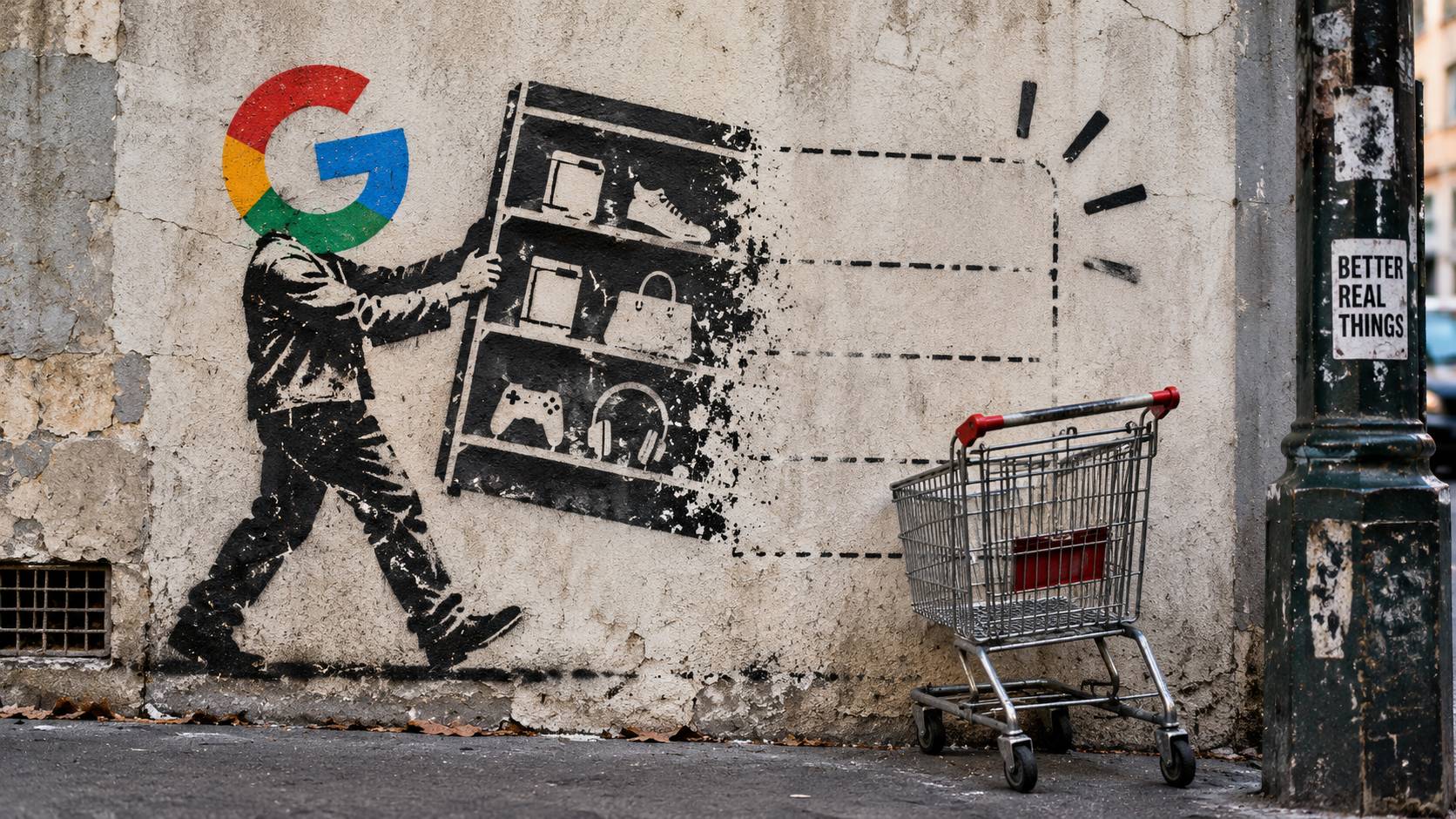
For years e-commerce teams were given a fairly simple proposition by Google. Build a good product feed. Keep your Merchant Center account healthy. Write accurate titles. Upload strong images. Maintain your prices, availability, GTINs and other product data. Follow Google's requirements and, if everything lined up, your products could earn valuable visibility without paying for every click. For merchants that visibility became part of the machinery of organic growth.
Then the shelf moved.
Across the European Economic Area changes to Google's shopping experience have put a spotlight on something retailers have always known intellectually but rarely had to confront so directly: a distribution channel can feel permanent right up until the platform changes the interface. Google's response to the European Union's Digital Markets Act has required significant changes to Search in Europe. Shopping and comparison services sit directly in the middle of that transformation.
For e-commerce businesses, this isn't merely another Google update. It's a reminder that platform dependency can easily masquerade as organic traffic.
And those are two very different things.
The digital shelf we started taking for granted
Think about a traditional supermarket. A product sitting at eye level has an enormous advantage over one hidden on the bottom shelf. Consumer brands understand this so well that physical shelf placement is negotiated, measured and fiercely protected.
Google Search created its own version of that shelf.
Search for a commercial query and, depending on the market and query, Google can show rich product experiences containing images, prices, ratings, availability and merchants. Instead of reading through ten blue links, shoppers can begin comparing products almost immediately.
That visual real estate is incredibly valuable. Google also opened opportunities for merchants to appear through free listings. Suddenly Merchant Center wasn't relevant only to companies running Shopping ads. Product feeds became an organic acquisition asset too.
This changed the work of e-commerce SEO.
Teams that had historically obsessed over category pages, internal links and traditional rankings also needed to think about product feeds. Titles had to match search behavior. Product identifiers needed to be correct. Images mattered. Structured product information mattered. Inventory accuracy mattered.
For sophisticated retailers feed optimization became another discipline. And it worked because Google had something merchants wanted: attention. The arrangement could feel surprisingly stable. Upload structured information about your inventory. Google organizes that information and potentially gives your products visibility. Shoppers discover the products. Merchants receive traffic.
But there was always an important sentence hiding underneath the arrangement. Google owns the shelf.
Then regulation changed the store
The Digital Markets Act was designed to regulate the behavior of very large digital platforms that the European Commission designates as "gatekeepers." Google is one of them. Among other obligations the DMA restricts gatekeepers from unfairly favoring their own services over competing services operating on their platforms.
That principle has significant implications for Google Search.
If Google simultaneously operates the dominant search engine and shopping-related services that receive prominent placement within that search engine European regulators have obvious questions about whether competing comparison services receive fair treatment. Google has consequently made a series of changes to its European Search experience as part of its DMA compliance work. The company has publicly described experiments and modifications involving comparison sites, suppliers, direct suppliers and specialized search experiences. It has also argued that some regulatory requirements can make the Search experience worse for users and reduce direct traffic to businesses. Regulators and Google don't necessarily agree about what the ideal outcome should look like.
That's an important distinction. It would be too simplistic to tell this story as "the EU told Google to delete free shopping listings."
The reality is more complicated.
The DMA establishes obligations. Google decides how to redesign its products to comply with those obligations. Regulators then evaluate whether those changes actually satisfy the law. Meanwhile merchants, comparison services and consumers experience the consequences of those design decisions. But from the perspective of an e-commerce operator the strategic lesson doesn't require choosing a side in that argument. Regulation changed the incentives and constraints around a major platform. The platform changed. And businesses downstream discovered how exposed they were to a user interface they didn't control.
Free listings aren't necessarily gone. That's not the point.
There's an important piece of nuance here. Google's free product ecosystem has not simply ceased to exist. Google continues to document free listings and potential unpaid product visibility across eligible Google surfaces. Depending on the market and other factors these can include places such as the Shopping tab, Google Images, Google Lens, YouTube and other Google experiences. Eligibility, however, has never meant guaranteed visibility. And not all placements are equally valuable. Losing or reducing a product module inside the main Google Search experience can matter much more than retaining eligibility somewhere deeper in Google's ecosystem.
Imagine a retailer being told that its products are still available in the shopping mall, except its display has moved from the entrance to a corridor three floors away. Technically the store still has visibility. Commercially that doesn't make the locations equivalent. This is why e-commerce teams should resist binary thinking about these changes.
The question isn't simply:
"Do free listings still exist?"
A better question is:
"Where does unpaid product visibility appear now, how prominent is it and how much qualified traffic does each surface actually produce?"
That is what ultimately matters to a merchant.

Organic doesn't mean owned
This episode exposes one of digital marketing's most persistent category errors. We tend to divide acquisition into two buckets: paid and organic. Paid traffic costs money. Organic traffic doesn't. Simple.
But there's another distinction that is arguably more important: owned versus rented distribution. Your customer email list is closer to an owned asset. People deliberately typing your brand into a browser represents direct demand. A community that actively seeks you out has durable value. A useful website with repeat visitors is an asset. Your customer relationships are assets.
A product carousel controlled by Google is different.
You may not be paying Google for every click but Google still controls the environment that creates the click. Google decides the interface. Google determines eligibility. Google determines ranking. Google can introduce new modules. Google can remove old modules. Google can change the amount of screen space devoted to them. Google can respond to regulation, competitive pressure, new technologies or its own business priorities.
So the absence of a media charge does not magically transform platform distribution into owned distribution. It simply means the current price of that particular click is zero. That is a very different proposition.
Merchant center optimization wasn't wasted work
None of this means retailers were foolish to invest in Merchant Center. Quite the opposite.
A high-quality product feed remains useful infrastructure. Clean product data can support paid campaigns, free product experiences and other shopping-related surfaces. The discipline required to maintain accurate titles, prices, inventory, identifiers and images also has value beyond any single placement. The mistake isn't optimizing for Google. The mistake is allowing Google to become the business. There is a meaningful difference between using a platform aggressively and becoming structurally dependent on it.
If Google sends 15% of your acquisition traffic and changes a feature you have a marketing problem. If Google sends 70% of your acquisition traffic and changes a feature you may have a business problem. The same logic applies beyond Google. Amazon sellers learned it. Publishers dependent on Facebook learned it. Creators dependent on Instagram learned it. Businesses built around app-store discovery learned it. Website owners affected by major algorithm updates learned it.
Every platform offers distribution in exchange for participation in an ecosystem it controls. That exchange can be extraordinarily profitable. But the economics can change without asking your permission.
The hidden price of "free" traffic
The phrase "free traffic" was always slightly misleading. Earning organic visibility costs money. Someone builds the website. Someone manages technical SEO. Someone produces content. Someone optimizes product feeds. Someone fixes Merchant Center errors. Someone monitors inventory mismatches. Someone creates images. Someone analyzes rankings and conversion rates.
Companies can spend hundreds or thousands of working hours building systems designed to perform well inside another company's distribution environment. The media cost may be zero. The dependency cost isn't. This distinction matters because it changes how businesses should calculate risk.
Imagine two acquisition channels producing exactly the same annual revenue. Channel A requires substantial operational work but the business controls the audience relationship. Channel B also requires substantial operational work but a third-party platform can dramatically alter distribution through a policy or interface change. Those channels should not carry the same strategic value simply because neither charges for each impression. One is building leverage. The other may be borrowing it.
What e-commerce teams should do now
The wrong reaction would be panic. The equally wrong reaction would be assuming nothing important has happened because some free Google surfaces remain available. A better response is to measure exposure. Start by separating Google traffic more carefully. Don't put every unpaid Google visit into one giant "organic" bucket and call the job finished.
Understand which search features and landing-page types are actually driving sessions and revenue. Watch changes in impressions, clicks, conversion rates and product-level visibility by country. EEA performance should be analyzed separately from markets operating under different product experiences.
Then continue improving your product data.
Merchant Center remains strategically important. Feed quality still influences Google's ability to understand products and the same infrastructure can support paid Shopping activity and other Google surfaces. But simultaneously invest in channels that make customers more likely to come back without needing Google to rediscover you. Email is an obvious example. So are loyalty programs, useful post-purchase communication, subscriptions where appropriate, communities, direct traffic and genuine brand demand.
Content also matters but not simply as another attempt to please an algorithm. Build resources customers deliberately seek out: buying guides, original research, tools, expert advice, comparisons, videos and information that helps someone make a decision. Develop partnerships. Work with creators who have genuine relationships with your potential customers. Build affiliate programs when the economics make sense. Explore marketplaces strategically rather than reflexively. Strengthen referral loops.
And most importantly, give customers a reason to remember who they bought from. If a shopper discovers your product through Google, purchases it and six months later has to search Google again to remember your company exists Google still owns an uncomfortable amount of that customer relationship.
The first click may come from a platform. The second purchase doesn't have to.

This is bigger than Google shopping
The most useful lesson here isn't about one carousel. It's about how modern internet businesses are constructed. Platforms create enormous opportunities precisely because they aggregate attention. Google aggregates search intent. Amazon aggregates shoppers. TikTok aggregates entertainment and discovery. Instagram aggregates audiences and creators. YouTube aggregates video consumption.
There is nothing inherently wrong with building on those platforms. Refusing to use them because they aren't owned would be commercially irrational for many businesses. The goal isn't independence from platforms. It's resilience across platforms. Use Google while Google works. Optimize Merchant Center. Run Shopping campaigns when the economics work. Pursue free visibility wherever it remains valuable. Test new Google surfaces.
But recognize what you're doing. You're accessing somebody else's distribution network. And access is not ownership.
The shelf can always move
For years e-commerce marketers optimized feeds to earn a position on one of the internet's most valuable digital shelves. They weren't wrong to do it. The traffic was real. The customers were real. The revenue was real.
But the permanence was never real.
The changes happening around Google's European shopping experience make that easier to see. A regulatory regime can change. A platform can respond. A familiar search feature can be redesigned, reduced, relocated or removed. A traffic source that looked like part of the natural architecture of the internet can suddenly reveal itself for what it always was: a product decision.
That's the uncomfortable reality behind platform dependency. The most dangerous traffic source isn't necessarily the one you pay for. Sometimes it's the one you've received for free for so long that you started believing it belonged to you. Keep optimizing the feed. Keep competing for the shelf.
Just build a business that can survive when the shelf moves.