Please enjoy the film. Your cart is waiting.
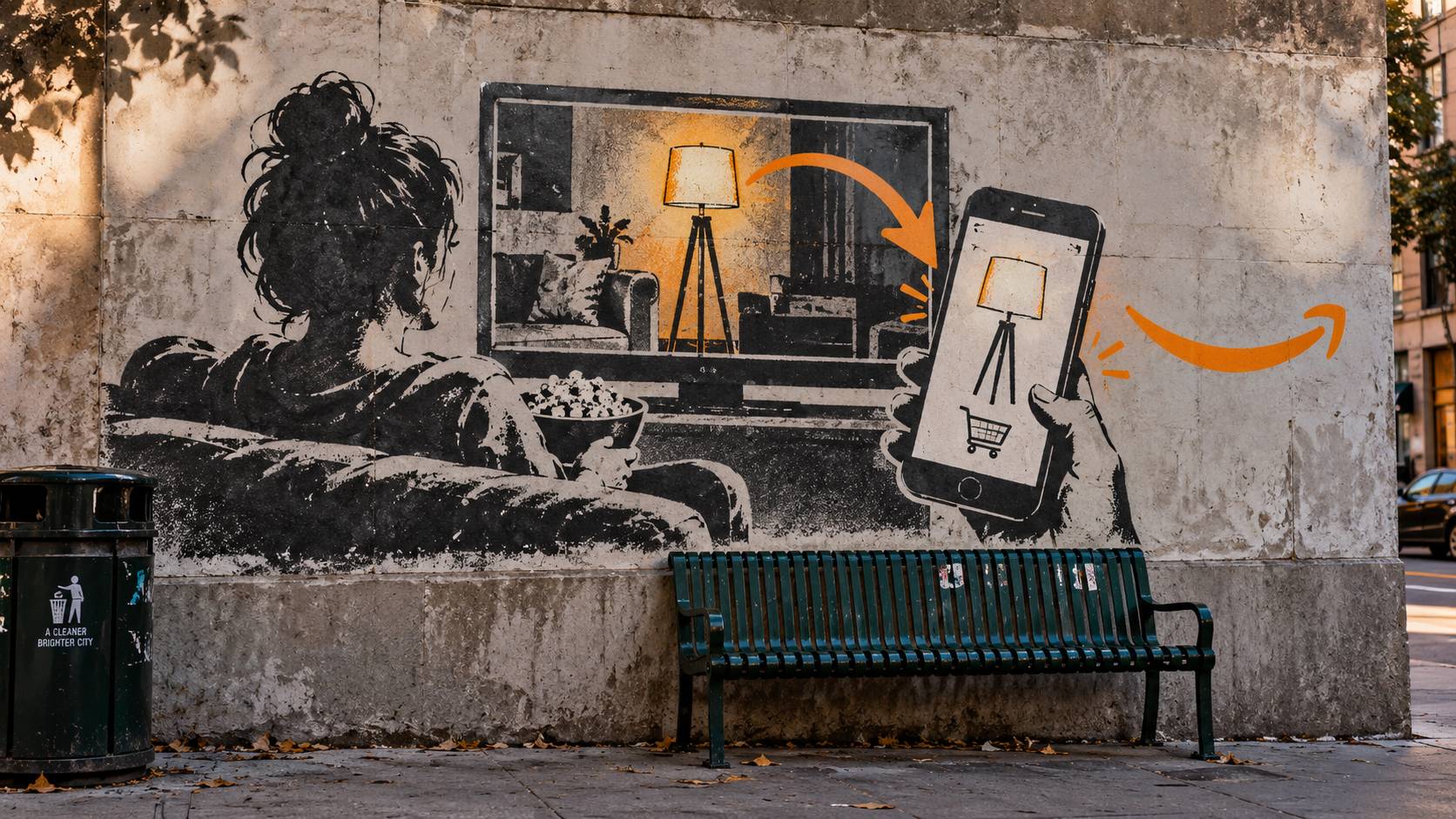
You’re watching a show on Prime Video when you notice the lamp. It’s sitting in the corner of an apartment you have never been inside, owned by a character who doesn’t exist. But suddenly you want it. A few years ago that moment probably ended there. Maybe you would remember the lamp. Maybe you would Google something vague like “round brass lamp from TV show” after the episode. Maybe someone on Reddit had already identified it. More likely you would forget about it before the credits rolled.
Amazon wants to eliminate all of that.
The company is dramatically expanding shopping inside the Prime Video ecosystem. Its “Shop the Show” experience, previously available across roughly 1,300 titles, now works with more than 8,000 movies, television shows and live sports titles in the U.S. More interestingly, Amazon has introduced something called “Shop the Scene.” And this is where the story gets bigger than shoppable television.
Shop the Scene uses Amazon Lens visual-search technology to help viewers find products inspired by what they are seeing on screen. Notice a sweater a character is wearing? A chair in the background? A piece of home décor? Amazon can turn the scene into a shopping query. Product placement is starting to become product checkout.
The screen Is becoming a search box
Amazon has been experimenting with the connection between entertainment and commerce for years. Its original Shop the Show experience was relatively straightforward. While watching Prime Video viewers could open the Amazon Shopping app, search for “Shop the Show" and find merchandise and products connected to the title.
Watch Fallout for example and you might discover collectibles or apparel. Watch a sporting event and you could find team merchandise. It was essentially a digital merchandise table attached to the content.
Shop the Scene changes the concept. Instead of asking: “What products are officially associated with this show?” Amazon can increasingly answer a much more valuable question: “What is that thing I’m looking at?” While watching a supported title viewers can open the Amazon Shopping app. When the phone and television are signed into the same Amazon account the app can recognize what is currently playing and synchronize the shopping experience with it. The viewer can then select a scene. Amazon Lens analyzes what appears in that scene and surfaces similar products from Amazon’s enormous catalog. Amazon gives the example of someone watching Off Campus and noticing a sweater worn by the character Hannah. Instead of trying to identify the sweater manually the viewer can open the synchronized storefront, tap the scene and see visually similar products.
The important word is similar.
Amazon does not necessarily need to sell the exact sweater. It simply needs to understand what made you want it. That distinction could turn out to be enormously important.
Product placement without the product placement
Traditional product placement has always depended on coordination. A brand gets its soda can onto a table. A particular car appears in a chase scene. A character prominently uses a recognizable phone. Sometimes money changes hands. Sometimes products are supplied to productions. Sometimes a brand simply benefits from appearing naturally in popular culture.
But the commercial opportunity traditionally belonged primarily to the product that actually made it onto the screen. Visual search changes that equation. Imagine an actor wearing a $2,000 designer jacket in a television series. Amazon doesn't sell that exact jacket. That used to be the end of the commercial relationship. Now Amazon can potentially say: Here are 25 jackets that look like it. The entertainment creates the desire. The visual-search system translates that desire into attributes - shape, color, style, material, silhouette - and the marketplace supplies alternatives. The object on screen becomes less like an advertisement for one particular product and more like a search query for an entire category.
That is a very different model of product discovery.
And it means that practically any visually distinctive object in entertainment could become commercially useful, even when no formal product-placement agreement exists:
- The couch.
- The sunglasses.
- The coffee maker.
- The sneakers.
- The jacket.
- The rug.
- The lamp.
- The set itself becomes a catalog interface.

Amazon has been building toward this for years
Shop the Scene may feel futuristic but the underlying technology isn't appearing from nowhere. Amazon has invested heavily in visual product search. In a 2022 research paper Amazon researchers described “Shop the Look" - a large-scale visual-search system for fashion and home products. One of the fundamental challenges they discussed was connecting ordinary photographs - the messy images people encounter in the real world - with the clean product photography found in Amazon’s catalog.
That is essentially the problem Amazon now gets to attack using entertainment. A television frame is messy. An actor isn't posing against a white ecommerce background. The jacket may be partially hidden. Lighting is cinematic. Furniture may appear at an angle. Objects overlap. The camera moves. Yet if computer vision can translate that scene into a useful product match Amazon gains something extremely powerful:
- A search engine that doesn't require words.
- You don't have to know what something is called.
- You don't have to know the brand.
- You don't have to describe it correctly.
- You just have to see it.
Amazon’s own technical material says Shop the Scene uses frames supplied through Prime Video's X-Ray systems as entry points into Amazon Lens product matching.
That connection matters.
Amazon already knows what you're watching. X-Ray already understands information associated with the content. Amazon Lens understands products. Amazon Shopping knows how to sell them. Amazon checkout knows how to complete the transaction.
Each component existed independently. Now Amazon is connecting the pipes.
The real innovation is removing the search
Ecommerce companies have spent decades removing friction from purchasing. First you had to visit a store. Then you could order from a website. Then payment information was saved. Then came one-click purchasing. Then same-day delivery.
But there is another kind of friction that happens much earlier. It exists between desire and search. You see something you like. Then you have to figure out what it is. Then you have to decide what words to type. Then you have to search. Then you have to sort through results.
Every step is an opportunity to abandon the purchase. Visual commerce attacks that entire sequence:
- See.
- Tap.
- Shop.
The significance of Shop the Scene isn't that Amazon has put another shopping feature inside Prime Video. It is that Amazon is trying to shorten the distance between “I want that” and “here it is.” That distance may eventually approach zero.
Entertainment is becoming a discovery engine
For years ecommerce has largely been built around intentional shopping. You need running shoes so you search for running shoes. You need a desk so you browse desks.
Social media changed this behavior significantly. Instagram, TikTok, Pinterest and creators turned content feeds into product-discovery engines. Consumers increasingly encountered products before consciously deciding to shop for them.
Entertainment may be the next major surface. The difference is psychological. When someone opens an ecommerce website they are already in shopping mode. When someone watches a movie they aren't. They are watching characters live inside carefully designed worlds. Costume designers choose clothes. Production designers choose furniture. Set decorators choose lamps, glasses, kitchenware, artwork and hundreds of other objects.
Those choices help create aspiration. We don't simply see a chair. We see a chair inside the beautiful apartment of a character whose lifestyle has been made emotionally interesting to us. Context creates desire. Amazon's opportunity is to capture that desire before it evaporates. In that sense Prime Video is no longer only competing for viewing hours. A viewing hour can potentially become a discovery hour.
What happens to product placement?
This creates fascinating questions for brands. Historically getting your actual product into popular entertainment could generate enormous cultural value. That won't disappear. But imagine the new competitive environment:
- A character wears Brand A's jacket.
- The viewer likes the look.
- Amazon Lens analyzes it.
- The viewer buys Brand B's visually similar jacket.
Who benefited from the product placement? Brand A generated the desire. Brand B captured the transaction. Amazon owned the bridge between them.
That could make visual similarity increasingly valuable inside marketplaces.
For sellers product photography may become more than a way of persuading shoppers after they arrive at a listing. Images could increasingly determine whether the product is retrieved in the first place.
A marketplace optimized around text asks:
What keywords describe this product?
A marketplace connected to visual entertainment asks:
Does this product look like the thing the customer just saw?
Those are very different optimization problems.
Amazon has an advantage few streaming companies can copy
Plenty of streaming companies could technically make shows shoppable. Amazon's advantage is what sits behind the video player. Prime Video is connected to one of the largest ecommerce ecosystems ever built. Amazon has the entertainment. It has the customer accounts. It has the shopping app. It has product images and catalog information. It has visual-search technology. It has payments. It has fulfillment. It has advertising infrastructure. And increasingly it has the connective tissue between all of them.
That makes Prime Video strategically unusual.
For most streaming services the end of the customer journey is another episode. For Amazon, an episode can potentially lead somewhere else entirely:
- Watch.
- Discover.
- Shop.
- Buy.
- Deliver.
All without leaving the broader Amazon ecosystem.

There is a risk: sometimes people just want to watch TV
There is however an obvious danger. Nobody wants every movie to feel like a shopping mall. Entertainment works partly because audiences can become absorbed in it. If every jacket, coffee mug and sofa starts screaming “BUY ME" the experience becomes exhausting.
Amazon appears aware of this tension. Shop the Scene primarily uses the phone as a second screen and transactions are completed there rather than turning the television itself into a giant checkout page. The new Shop tab also sits inside X-Ray rather than permanently covering the video.
That separation is important. The best version of shoppable entertainment is probably invisible until someone wants it. You notice the lamp. You become curious. Then the shopping layer appears. Not the other way around.
There are also broader questions Amazon will have to navigate: how recommendations are ranked, how clearly sponsored or commercial relationships are disclosed, how customer viewing and shopping behavior interact and whether consumers understand why particular products are being recommended.
As entertainment and commerce merge transparency becomes increasingly important.
The movie isn't the store. It's the storefront.
The phrase “shoppable TV” almost undersells what is happening. It makes the concept sound like television with buy buttons attached. The more consequential shift is that computer vision can transform media itself into an input for commerce. Movies become searchable. Television sets become searchable. Sports broadcasts become searchable.
Eventually the same logic could extend far beyond professionally produced entertainment. See a chair in a creator's video. See shoes during a livestream. See sunglasses in an old movie. See a kitchen in a cooking show.
The pixels themselves can become queries. That changes the role of the screen. For decades advertising tried to move consumers from media toward commerce. See an advertisement. Remember the brand. Visit the store. Search for the product. Buy it.
Amazon is collapsing those stages.
The inspiration and the transaction can increasingly happen inside the same ecosystem - and almost at the same moment. That may be the most interesting thing about Shop the Scene. Amazon isn't simply putting products into movies. Products have been in movies forever. It's building technology that can look at nearly anything inside a movie and ask:
Would you like to shop that?
The future of product placement may therefore have very little to do with placement. The product doesn't necessarily need to be an advertisement. The scene itself becomes the advertisement. The camera becomes the catalog. And the moment you think, I want that, Amazon wants to already be waiting with the checkout.