Outsource Everything. Even the Crime.
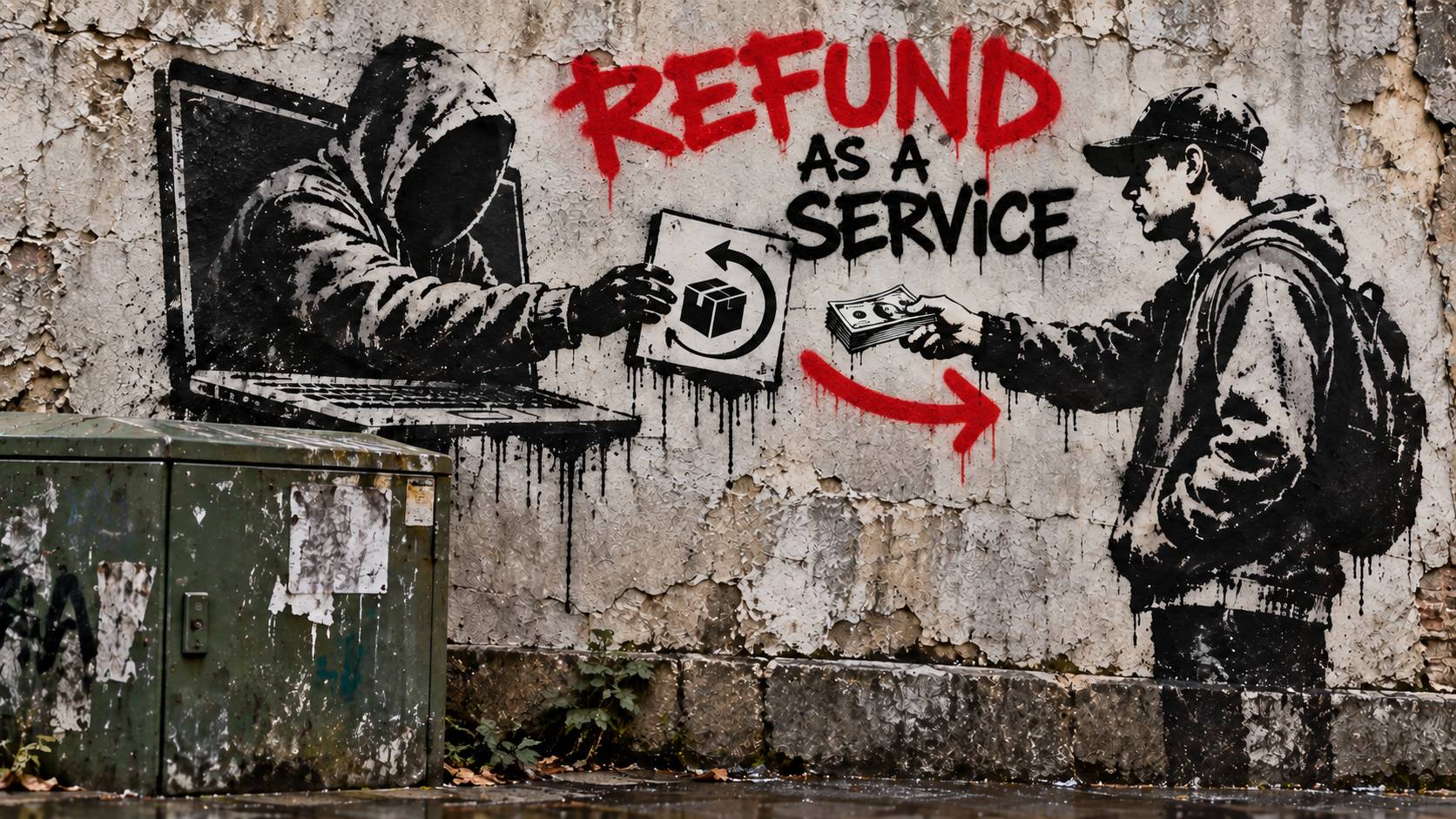
For years refund fraud was easy to picture. A customer receives an online order, contacts customer service and claims the package never arrived. Or they return a different item, insist the product was damaged or exploit a generous returns policy. The retailer loses money. The customer walks away with a refund. It was dishonest but it was usually understood as an individual act.
That model is changing.
Refund fraud is increasingly being described not merely as something customers do but as something customers can outsource. An underground ecosystem of refund operators and organized groups has emerged around e-commerce. These operators advertise their services through private online communities and messaging platforms, including Telegram and Discord. A customer makes a legitimate purchase, hands the transaction details to an operator and pays that operator to obtain a refund on their behalf.
In its simplest form the transaction looks like this:
Customer buys legitimately → sends order details to a refund operator → operator executes or engineers the fraudulent refund → customer receives the refund → operator takes a percentage.
That distinction matters. Because once fraud becomes a service retailers are no longer dealing only with dishonest customers. They are dealing with specialists.
From “friendly fraud” to a commercial service
Return and refund abuse already represent a significant problem for retailers. Recent research involving roughly 5,900 consumers across the United States, United Kingdom, Canada and Australia found that 17% acknowledged engaging in some form of return misconduct. That category is broader than outright criminal fraud. It can include behaviors of varying seriousness, from abusing return policies to deliberately making false claims. So the statistic should not be interpreted as meaning that 17% of consumers are professional fraudsters. What it does demonstrate is something important: abusing returns and refunds is not an obscure behavior confined to a tiny criminal fringe. And surrounding that larger pool of opportunistic abuse is a more organized economy.
Instead of figuring out how to manipulate a retailer themselves customers can seek assistance from people who already understand the process. These operators may know which merchants are easier to target, what kinds of claims trigger additional verification, how different delivery circumstances are handled and where retailers have tightened their controls. The customer supplies the purchase. The operator supplies the expertise. That is the essence of Refund-as-a-Service.
The fraud has developed its own supply chain
One of the most important changes in modern cybercrime has been specialization. Criminals do not necessarily need to possess every skill required to conduct a fraud operation. Services, tools and access can be bought from other participants. Refund fraud increasingly fits that model.
A person who wants a free laptop, pair of sneakers or expensive consumer product does not necessarily need to understand the retailer's fraud controls. They may simply find someone who claims they can make the refund happen. The operator typically gets paid through a fee or percentage of the successfully refunded order. That creates a strange inversion of the normal e-commerce economy.
The retailer sells a product. The customer buys the product. And then a third party sells the customer a service designed to reverse the payment while allowing the customer to retain the economic benefit. The fraud itself becomes a product.
Operators can advertise success rates, supported merchants, order limits and fees much as legitimate service businesses advertise pricing and capabilities. Communities can also exchange information about merchants, shipping companies and fraud controls. That makes the ecosystem more resilient.
When one technique stops working knowledge about the failure can spread. When retailers introduce new verification measures fraud communities can test them. When a merchant appears vulnerable information can circulate among people looking to exploit it. Retailers are therefore participating in an adversarial learning process whether they realize it or not.
Why Telegram and Discord matter
Platforms such as Telegram and Discord did not create refund fraud and the overwhelming majority of their users are not involved in criminal activity. But communication platforms can provide infrastructure that underground communities find useful. Private groups can bring together customers, operators and people selling related services. Reputation can be established through testimonials or claimed proof of successful refunds. Operators can publish price lists and rules. Customers can ask which retailers are currently being targeted successfully.
This dramatically lowers the barrier to entry. Historically someone attempting sophisticated refund fraud might have needed substantial knowledge of e-commerce systems. Today expertise can potentially be purchased. That is the same structural change that has appeared elsewhere in cybercrime. Ransomware developed affiliate programs. Phishing kits became commercially available. Stolen credentials became commodities. Botnets could be rented.
Fraud services followed the same logic: separate the person who wants the outcome from the person who possesses the technical or procedural knowledge necessary to achieve it. Refund fraud is another step in that evolution.

AI adds another layer
Artificial intelligence makes this development more significant although it is important not to exaggerate its role. AI did not invent refund fraud. Social engineering, manipulated evidence, false delivery claims and policy abuse existed long before generative AI became widely available. What AI changes is the cost of producing convincing material at scale.
Generative tools can help criminals create polished communications, alter or manufacture supporting material, translate messages, adapt language to different companies and produce content that appears more professional than something created manually. That matters because many fraud controls ultimately involve judgments about whether evidence appears legitimate. The danger is therefore not some autonomous AI system independently stealing refunds.
It is amplification.
A person with limited writing, editing or language skills can suddenly produce more credible-looking material. An operator serving many customers can automate portions of repetitive work. Content can be customized faster. AI can make existing fraud workflows cheaper, faster and easier to scale. And that creates a particularly uncomfortable problem for retailers: the cost of generating questionable evidence may fall faster than the cost of verifying it.
Fake tracking changes the equation
Shipping is one of the most vulnerable points in online commerce because several independent systems have to agree about what happened.
- The retailer has an order record.
- The warehouse has fulfillment data.
- The carrier has tracking information.
- The customer knows what actually arrived.
- The payment provider sees the transaction.
- Customer service sees the complaint.
Fraud thrives in the gaps between those systems.
Refund operators have reportedly exploited shipping and tracking disputes as part of fraudulent refund attempts. At a high level the objective is straightforward: create enough uncertainty about whether an order was successfully delivered, returned or received that the merchant authorizes a refund. For retailers that means a tracking number can no longer always be treated as a complete representation of reality.
The important question becomes whether multiple independent signals tell the same story.
- Does the package weight make sense?
- Does the delivery location correspond with the customer?
- Does the return contain the expected product?
- Does the account have an unusual refund history?
- Are several supposedly unrelated customers displaying remarkably similar behavior?
The future of refund-fraud detection will depend increasingly on connecting those signals.
The economics favor the attacker
There is another reason Refund-as-a-Service is attractive: the incentives can be asymmetric. Imagine a customer purchases an expensive product. If a refund operator succeeds the customer potentially receives both the economic benefit of the product and the returned payment. The operator takes a percentage. If the attempt fails the customer may simply end up paying the legitimate purchase price they originally agreed to pay although account closures, investigations, debt recovery or legal consequences can also follow. For the operator, meanwhile, the business can potentially be repeated across many customers.
This creates something resembling a performance-based fraud industry. And professionalization changes behavior. An occasional fraudster might try one technique against one merchant. A specialist can learn from dozens or hundreds of attempts.
That produces data.
- Which merchants reject certain claims?
- Which orders receive manual review?
- What transaction values attract attention?
- Which controls have changed?
Criminal communities can accumulate this knowledge collectively. That is why treating each suspicious refund as an isolated customer-service problem can underestimate the threat. Individual incidents may be connected to a much larger ecosystem.
Retailers face a difficult trade-off
There is an obvious response to refund fraud: make refunds harder. Unfortunately that can create another problem. Most customers requesting legitimate refunds are not criminals. Online shopping depends heavily on trust. Customers purchase products they have never physically examined, often from companies they have never interacted with before. Flexible returns reduce the perceived risk of making that purchase.
If retailers respond to fraud by introducing aggressive verification everywhere, legitimate customers pay the price.
- Refunds take longer.
- Customer-service interactions become confrontational.
- More documentation is required.
- Honest claims are rejected.
- Customers leave.
The challenge, therefore, is not simply stopping refunds. It is distinguishing legitimate customers from organized abuse with greater precision. That requires moving away from simplistic rules toward risk-based systems.
A single missing-package claim from a long-standing customer may look very different from multiple expensive claims connected through overlapping devices, addresses, payment methods or behavioral patterns. Context matters.
Retailers need to detect networks, not just claims
Refund-as-a-Service also changes what businesses should be looking for. Traditional fraud detection often evaluates individual transactions.
- Was this payment suspicious?
- Is this return unusual?
- Does this account have too many refund requests?
Those questions remain useful but organized refund fraud requires another question:
Are apparently separate incidents actually connected?
If one operator is handling refund claims for many customers patterns may appear across those claims even when the customer accounts themselves are different. Retailers and payment providers therefore have an incentive to examine relationships between accounts, devices, addresses, order behavior, delivery information, customer-service interactions and historical claims.
The objective is not merely to identify a suspicious refund. It is to identify the infrastructure behind repeated suspicious refunds. That also means fraud teams, customer-service teams, logistics providers and payment teams cannot operate entirely in isolation. The evidence required to understand an incident may exist across all of them.

The word “service” is the important part
The most significant part of “Refund-as-a-Service” is not the refund. It is the service. Services reduce complexity. They allow specialists to perform work for people who lack the time, knowledge or ability to perform it themselves.
In legitimate markets that produces enormous economic value. In criminal markets it produces scale. The person committing the underlying fraud no longer needs to understand the entire process. They only need to know where to find someone who does.
That expands the potential customer base for fraud. And once operators compete for customers another familiar market dynamic appears: specialization. One group may concentrate on particular retailers. Another may focus on high-value electronics. Others may claim expertise in specific delivery or dispute scenarios. This does not mean every advertised underground service works as promised. Criminal marketplaces contain scams, exaggeration and unreliable claims of their own. But the broader development is more important than the credibility of any individual operator. Fraud knowledge is being packaged and sold.
This is bigger than returns
Refund-as-a-Service should also be understood as part of a larger transformation. Cybercrime is increasingly modular. Instead of one criminal organization controlling every stage of an operation underground markets allow capabilities to be assembled. Someone supplies credentials. Someone else supplies infrastructure. Another person provides automation. Another launders proceeds. Another specializes in social engineering. Refund operators fit naturally into this environment.
That makes the boundary between cybercrime, payment fraud and traditional retail fraud increasingly difficult to define. A fraudulent refund might begin with a perfectly legitimate online purchase and eventually involve manipulated digital evidence, social engineering, payment disputes, logistics systems and anonymous online communities.
For a retailer, the final symptom may still look deceptively ordinary:
Refund approved: $1,299.
What happened behind that refund may be anything but ordinary.
The next fraud battle is about trust
E-commerce was built by removing friction.
- One-click checkout.
- Fast shipping.
- Instant refunds.
- Automated customer service.
- Easy returns.
Those innovations made online shopping dramatically better. They also created systems designed around the assumption that most customers are acting in good faith. That assumption remains essential. Retailers cannot treat every customer like a suspect.
But professional fraud businesses are learning how to monetize the trust built into those systems. That is what makes Refund-as-a-Service important. It represents a shift from opportunistic abuse toward an ecosystem in which fraud expertise can be packaged, marketed and purchased.
The customer no longer has to know how to manipulate a refund process. They can potentially hire someone who does. AI may accelerate that ecosystem. Underground communities may distribute its knowledge. Specialists may continue testing retailers' defenses.
But the fundamental change has already occurred.
Refund fraud is no longer necessarily one dishonest customer telling a company:
“My package never arrived.”
Increasingly, there may be an entire business standing behind that sentence.