When the Loudest Retailer Says Nothing
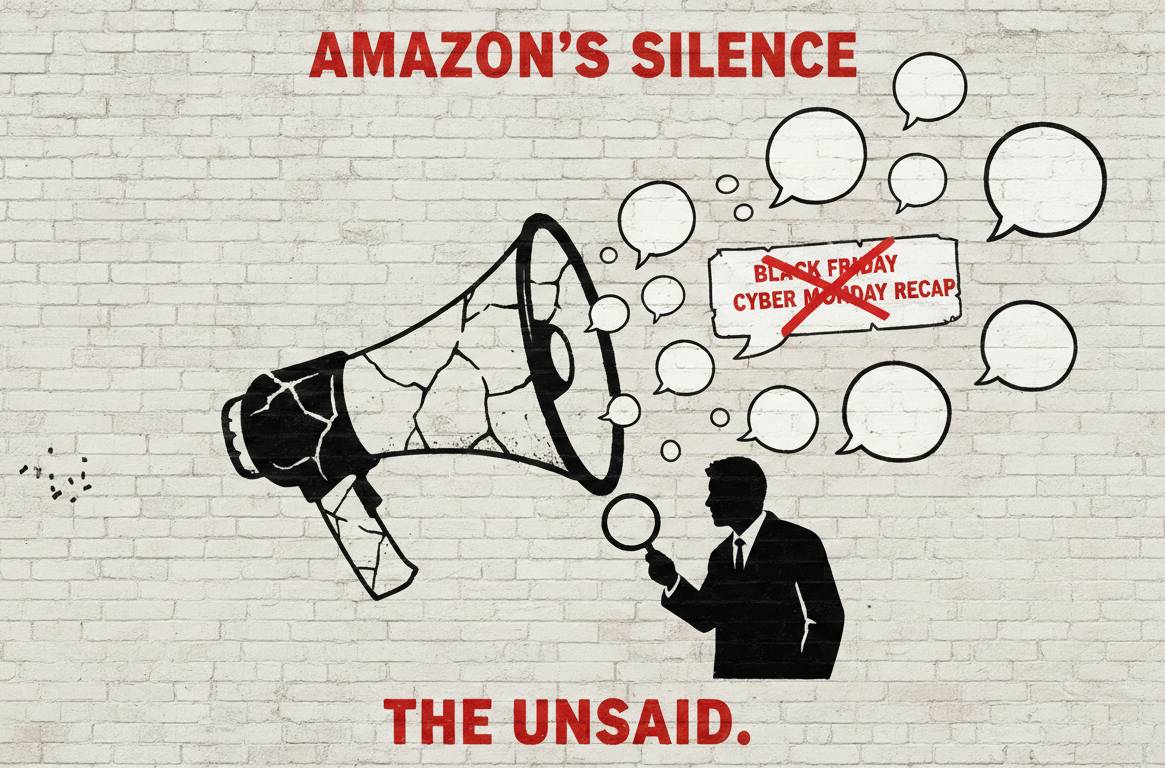
Amazon deviated from a significant holiday tradition by not issuing its familiar post, Black Friday/Cyber Monday sales recap in 2025, marking the first time it has kept silent after the big shopping weekend since at least 2016. For a long time, Amazon's PR department would proudly announce that the shopping period from Black Friday through Cyber Monday was "our biggest ever, " typically without disclosing actual revenue figures. However, no such press release or blog post was published in the days or weeks after Cyber Monday this year. This quietness surprised the ecommerce community. Why would the world's largest e, commerce company suddenly stop talking about one of its busiest shopping events?
In this article, we will look at possible motives for Amazon's silence, see how Amazon's quietness compares with the ways in which its competitors Walmart, Target, and Shopify announced their BFCM (Black Friday/Cyber Monday) results, and provide main lessons for e, commerce brands and agencies. So, let's grab a cup of coffee and talk about this in a relaxed, conversational way, because even in e, commerce, sometimes the unsaid can be as informative as the said.
Amazon Breaks a Black Friday Tradition
Amazons decision to not publish BFCM 2025 recap implied a quite strong change of its holiday communication practice. Since 2016 Amazon had consistently produced a post, Thanksgiving weekend recap, emphasizing how the shopping event was bigger than ever, and usually filled with cheerfulness about record, breaking sales and items sold. These press releases had become a regular part of the season, a quick glance at consumer spending, even if Amazon traditionally kept the exact dollars under wraps. In 2022, for example, Amazon announced that its combined Black Friday & Cyber Monday event was "its biggest ever" and recorded the number of items sold. Similar announcements go back several years, showing how Amazon used these updates to signal momentum during the critical holiday period. Not in 2025. At the time of writing, more than a month after Black Friday and Cyber Monday 2025, Amazon has still not published a recap of the weekend. No statement such as "millions of items ordered" or "holiday shopping weekend we've ever seen." The silence is very much out of character compared to nearly a decade of Amazon PR tradition. It's as if you're watching a fireworks show that you expect every year, but suddenly, on this one, the sky remains dark. E, commerce insiders noticed and it resulted in numerous conversations, as well as guesses.
It should be pointed out that Amazon held some huge Black Friday and Cyber Monday sales events in 2025, and consumers showed up according to all external data. Data from Adobe Analytics showed that U.S. consumers spent record amounts online during Cyber Week (the five, day period from Thanksgiving through Cyber Monday), with the total value of online holiday sales hitting new heights. After Cyber Monday, Amazon even released a statement through Business Wire, referring to its 11, day Black Friday/Cyber Monday period as "the biggest ever" and mentioning a purchase of over 1 billion items worldwide. What has changed is how Amazon has handled the follow, up: instead of amplifying those record stats in a dedicated "recap" press release on its blog or news site, the company simply went quiet past that initial announcement.
The following are some possible reasons behind such a response:
A lack of super sales (purely hypothetical): The notion that Amazon's Black Friday/Cyber Monday results may not have been good enough to talk about is one of the theories that gets thrown around. If sales were merely "fine" or only a little bit higher, then Amazon would have decided to not make a big deal out of it. It is understood that no company would want to put out a press release saying, "we are okay, but not great." Nevertheless, most analysts don't see it that way here. Actually, experts believe that despite the economic difficulties, Amazon has experienced quite a good holiday season in 2025. One report suggested that Amazon's silence "does not seem to be indicative of poor sales" in general, analysts expect that Amazon will report strong year, end results. The early figures are consistent with this: total online spending during the holidays reached record levels (up approx. 6, 7% compared to the previous year), and Amazon was expected to slightly surpass the average growth for the e, commerce industry. So while we can't 100% exclude the possibility that Amazon may have had a lackluster performance, the general consensus states that this silence was definitely not caused by a disastrous flop of the company. Most likely, the sales were perfectly fine, just communicated using a different method.
Strategic silence in order not to attract investor hype: One could argue that a more valid reason for Amazon's silence might be its strategic decision to control carefully the communication of the resulting hype among investors, and not to scare them inadvertently. Earlier on, Amazon's post, Cyber Monday hyping, e.g., "biggest ever, " might have set expectations for the company's quarterly financial results. The case here: when Amazon announces "record sales this weekend, " financial analysts might start forecasting higher revenue for Quarter 4, thus creating inflated expectations that Amazon would need to satisfy or exceed with its earnings report. Neil Saunders, GlobalData's managing director, observed the fact that even seemingly innocent optimistic comments might lead to unintended consequences for a highly scrutinized company like Amazon. In Saunders' view, shopping events of such a magnitude (Prime Day, Black Friday, etc.), have reached such a level for Amazon that "even throwaway lines on growth" can expose the company to speculation and misinterpretation. By not saying anything, Amazon can keep the level of expectations under control and hold the focus on the official earnings which contain the full context such as profits, costs, and real figures. To use Saunders' expressions, the company is "becoming a bit tighter about what they release outside of earnings" thus only "reserving any discussion of performance for formal earnings calls." Therefore, it's a strategic silence aimed at allowing too much information to be leaked too fast."
Adjustments in Internal Data/Reporting Strategy: Amazon's action indicates that it is making a shift internally in deciding when and how it will release its numbers. The lack of a holiday sales recap was explained by an Amazon spokesperson, in essence, that now Amazon's Q4 includes multiple sales events (Prime Big Deal Days in October, an extended Black Friday "Deals Week, " etc.) so they "made the decision to incorporate performance reporting for these events in our quarterly earnings" rather than through separate press releases. Simply put, Amazon is putting all those comments into a quarterly earnings report (which is after the quarter) rather than doing mid, quarter victory pressers. This makes Amazon similar to many other big retailers, normally, most retailers don't release detailed sales figures or boast about specific shopping days until they report quarterly earnings. Unless the company is going to do something truly exceptional or out, of, the, ordinary, usually, the hard numbers are saved for investors behind closed doors. Amazon, which for several years was an exception by issuing those holly, jolly recaps, seems to be aligning with that standard in the absence of "things that have gone exceptionally well." It is quite a significant change in communication strategy: no less will be said to the media but more controlled messages will be spread.
The Media, Market Tactics are Being Changed (Press Releases have less Impact): Amazon might have figured out that it doesn't really gain much from BFCM press releases anymore which is another explanation for a change in behavior. With such types of announcements becoming regular, the media impact of these press releases has probably lessened over time. They never contained any actual revenue but instead were loaded with statements like a "record number of items sold" or "best ever" which, frankly speaking, were expected every year since e, commerce continues to grow, so naturally, each year is usually a record. Sky Canaves, a retail analyst at eMarketer, pointed out that these kinds of press releases depended on superlatives and offered very little real data thus, as the market matured, they became less newsworthy. At the same time, media outlets have developed a degree of jadedness toward "Company X says it had its biggest Black Friday ever (but wont say how much $$)" stories. Thus, it might cross Amazon's mind as to why they should issue a vague press release only to have reporters shrug at it, especially when this is just a repetition of "we broke records again" and no actual). Continuing with this thought, such a PR spree might no longer justify its cost. Amazon could better use this PR energy on other narratives (e.g. product launches, or feel, good stories about small businesses) and save the figures to the earnings season account. Basically, Amazon's media strategy is going through a transformation bypassing the yearly press release that has probably outlived its purpose.
Not Giving Competitors an Advantage: This last reason is quite speculative by not commenting, Amazon is not letting competitors figure out their holiday performance more precisely. Even though the old press releases didn't reveal much, they certainly confirmed things like "third, party sellers made up X% of sales" or "Y million items sold." Amazon's competitors (and marketplace sellers) very closely follow these particulars. Now the only thing that competitors can do is speculate a little bit about how Amazon's performance was until at the earnings call they are going to be provided with the bigger picture. It's a subtle competitive move; avoid showing your cards until the last moment. This is consistent with Amazon's generally secretive nature. Although Jeff Bezos brought the mantra "your margin is my opportunity" into the limelight, the new CEO Andy Jassy's slogan may be "your curiosity is my opportunity and I'll satisfy it on my terms."
To sum up, the fact that Amazon didn't do any kind of recapping of their Black Friday and Cyber Monday festivities mostly seems to be a matter of strategic communications rather than a signal of failure or trouble. It's likely that they had a pretty decent if not a fabulous holiday sales performance but they decided to control the narrative by giving it the quarterly earnings report treatment. Essentially, it's about the right timing, context, and maybe a little bit of, "let's not feed the hype machine unnecessarily." As e, commerce professionals, we must be able to sense such signals: Amazon is communicating a little bit like a regular retailer now, more reserved and patient.

Competitors Were Loud and Proud: Walmart, Target, Shopify & Others
Amazon's secretive approach sharply contrasts with how some of their competitors dealt with the 2023 Black Friday/Cyber Monday. While Amazon remained silent, others were more than willing to shout their BFCM victories from the rooftops, each for different reasons. Here is an overview of what three big players, Walmart, Target, and Shopify, had to say about their respective performances at the start of the 2023 holiday period and what it might indicate about the retail environment.
Walmart: As the largest brick, and, mortar retailer in the country (and an expanding e, commerce player), Walmart could not remain silent. The retailer put forward that the Black Friday/Cyber Monday period in 2023 was an online marketplace record, breaker for it. In a sellers, focused blog, Walmart disclosed that its Marketplace (third, party seller platform) had its greatest sales day ever during the BFCM week and even set a single, day conversion rate record in that timeframe. Electronics, toys, home goods, and beauty were the top product categories on Walmart.com over the weekend signaling that Walmart shoppers were not only interested in TVs and toys but also got deals in everyday categories. What would be the reason for Walmart to mention that? For one, it's a signal to sellers and brands: We are growing online, our marketplace is thriving, come sell with us! Walmart has been very determined in expanding its online marketplace, so announcing record BFCM marketplace sales publicly is both a brag and a recruitment tactic. Besides, it can be seen as a move to attract customers from Amazon, as the message behind this is, Amazon is not the only option for holiday e, commerce. The fact that Walmart demonstrated its percentage growth (e.g. 22% U.S. eCommerce growth in Q3, 43% growth in marketplace sales) and showed gains with high, income shoppers indicates that they are taking over the narrative that Walmart is digitizing and levelling up. Thus, while Amazon kept quiet, Walmart kind of said we enjoyed a very successful holiday season online, thank you very much.
Target: Target went for a slightly different and yet optimistic approach. Instead of a big announcement right after Cyber Monday, Target chose to reveal its holiday performance as part of a financial guidance update in January only. In mid, January 2024, Target raised its Q4 sales guidance, calling back to record high sales on Black Friday and Cyber Monday as factors contributing to the good performance.Target highlighted in a press statement that total sales for Nov, Dec rose 2.8% year, over, year with Black Friday and Cyber Monday being the two days that set the record for the company. Apart from that, they mentioned that digital sales increased by nearly 9%. In tose months, the two retailers reported digitally driven sales rising almost 9% as a result of a high number of same, day services like pickup and delivery. That was Targets way of saying: Holiday season went better than we expected even our two biggest days ever. That is a confidence booster to investors and a PR boost for Targets brand. Context: Target experienced a rough patch earlier in 2023, especially with the slowdown in sales of discretionary categories and consumers becoming more cautious with their spending. So, they are very happy to share positive holiday news, as that helps change the narrative about the company. By emphasizing BFCM record days, not only is Target making a nice comparison to its previous performance, but it is also demonstrating that it can compete during major events. Its quite remarkable that Targets tone was essentially the reverse of Amazons, Target wanted to be known for its great Black Friday and Cyber Monday (maybe to counter the "Target is struggling" story from the first half of the year). This shows how each retailer's communication strategy is influenced by its situation: Amazon, confident and under scrutiny, chose to remain silent; Target, recovering and wanting to prove itself, was loud about its wins.
If there is any company, living for Black Friday / Cyber Monday bragging rights, it has to be Shopify. Shopify does not sell directly to consumers, but its platform is used by millions of independent online stores, thus BFCM is a very important moment to demonstrate the success of those merchants (and, consequently, Shopifys success). As expected, Shopify was quick to put out a press release and real, time dashboards to show how much money was flowing through merchants' websites. This means that during the BFCM weekend in 2023, Shopifys merchants worldwide racked up a record $9.3 billion, representing a huge 24% increase over the previous years holiday weekend. To put it in perspective, this $9.3 billion figure is the gross merchandise volume (GMV) processed via Shopify from Black Friday through Cyber Monday. Shopify likes releasing these figures as a means of bragging about the strength of our network. They even released some fun facts: at one point on Black Friday, Shopify stores were making $4.2 million in sales per minute! Harley Finkelstein, the president of Shopify, gave a very enthusiastic quote describing how this shopping moment has now become a global commerce event, led by entrepreneurs and brands of all sizes. The tone was festive and uplifting, a call to arms for small businesses. From an e, commerce agency perspective, Shopifys openness is very beneficial: it provides a yardstick for how well D2C (direct, to, consumer) brands have generally done. And it contrasts very sharply with Amazons strategy. Shopify is basically doing the opposite to what Amazon does, they are disclosing aggregate sales figures (something Amazon notoriously never does in these weekend recaps) and they are having a lot fun with the data. Of course, Shopify is motivated to do this since it is a form of marketing for their platform. By broadcasting record BFCM sales, Shopify is effectively telling current and potential merchants, Stick with us, were growing and our merchants are killing it! It is also a sort of PR judo, casting Shopify's decentralized merchant army as a competitor against Amazons one, stop, shop dominance. Whatever the case, Shopifys public celebration of BFCM results totally underscores how quiet Amazon was by comparison.
Other retail and platform players also threw out some holiday tidbits. For example, Adobe and NRF (National Retail Federation) announced industry, wide highs (record online spending, strong store traffic) which was echoed by a number of companies. We even saw Temu, a newer player, boasting about setting the record for Black Friday sales (yes, that flashy shopping app apparently claimed to have hit ~$55M on Cyber Monday small in the grand scheme of Amazon/ Walmart, but a significant step up for them). The overall tone resonated with most retailers was cheerful a great number of them talking about records and consumer demand being better than expected. This only makes Amazons silence stand out as an exception even more. It's like you are at a party where everyone is raising their glasses to a wonderful night, and a big guest silently taking a sip of his drink without a word in the corner.
In summary, the rivals did light up the BFCM as a PR moment whereas Amazon skipped it. Walmart showed great e, commerce growth, Target indicated a comeback with record days, and Shopify celebrated its merchants success to the point of digital confetti. Each of them had different reasons: Walmart and Shopify to attract sellers and affirm growth, Target to build trust and demonstrate competitiveness. Amazon, secure in its position but conscious of the scrutiny, picked a different route. For the e, commerce brands and agencies, it is quite useful to identify such different plays. At a bigger picture level, those messages tell us that companies can be expected to have varying priorities and pressures based on the cues they have in their messages.
Key Takeaways and Next Steps for E-Commerce Brands and Agencies
1. Dont Place Too Much Faith in Amazons PR Tea Leaves: Previously, some brands and analysts would take a Black Friday press release from Amazon and treat it as a signal of early consumer mood ("Amazon says it was the biggest ever yay, people are spending!"). However, after Amazon narrowing the release of mid, quarter commentary, you will be required to seek hints about the market performance elsewhere when it comes to the Amazon marketplace. It's a good idea to diversify insight sources: the view of holiday trends should be shaped by industry reports (e.g., Adobe Analytics, NRF data), competitor announcements, and your sales data. Amazon will not be revealing mid, season secrets, so get into the broader market noise. The good news is the overall data for the 2023 holiday season is very encouraging online sales were record, breaking in general, and even Amazon skipping the press release doesn't change that fact. The message to brands: there was consumer demand, to which Amazon was indifferent not to hype it. So go ahead and plan your inventory and set up your marketing with the confidence that Black Friday/Cyber Monday is still the big event on the shopping calendar.
2. The Holiday Season Is Lengthening and Less Definite: According to Amazon, one of the reasons why it did not do a Black Friday recap was that its holiday deals now span over a longer time period (e.g., an 11, day Black Friday event, plus Prime October deals). This is in line with a broader trend the sales concentration at Black Friday/Cyber Monday is diminishing. Retailers are gradually being more retail sales, promotions starting earlier (October, early November) and extending them longer. A brand strategy based on the idea that the customer knows the one, weekend sprint must be changed to a holiday season, mix, from, a, marathon perspective. This change means you are going to have to figure out how to keep a customer from being sold in a longer time frame: perhaps multiple waves of promotions or a sustained campaign from the beginning of November upscale the result till late December. If Amazon is including all the holiday event results into one single quarter, end report, it means they consider the holiday season as a whole rather than giving the singular importance to the Black Friday weekend. You could think about doing the same: look at your Q4 performance as a whole, and dont worry if the Black Friday weekend itself is not your be, all, end, all. The totality of the holiday sales is what matters and the consumers rely on shopping earlier and later, not only in that five, day frenzy.
3.Watch What Competitors Say( and Dont Say), It Reveals Their Focus: Amazons silence versus rivals chatter discloses the focus of each one. Walmart talking about the growth of its marketplace? Thats a tip to brands: maybe its time to diversify your product range onto the Walmarts platform if you havent done it yet because they are clearly investing there and getting record results. Shopify bragging about $9.3B of merchant sales? That highlights the flourishing world of D2C and independent brands, maybe you need to make sure that your Shopify, powered storefront is optimized to get a part of the growing pie. Target revealing record digital days is a sign that they are finally coming live in the e, commerce world, which for agencies could mean the opportunities in Targets online marketplace or media network as Targets digital traffic goes higher on the big events. In other words, pay attention to these cues: the place where the competitors have the success is the place where the opportunities for brands are. If Amazon is not openly giving you the takeaways, get them from those who are speaking up.
4.Interpret the Silence Carefully, Its not always Negative: Its very easy to suppose no news is bad news but as we discussed, Amazons quiet attitude is certainly not due to the disaster. Brands or agencies should also exercise caution in drawing conclusions. If a platform or partner does not announce a public win, examine the situation. In Amazons example, their quietness was a deliberate decision, not a sign that BFCM is losing its significance. The lesson: do not start panicking just because a statistic is not loudly announced. Investigate to figure out the reasons behind it. In Amazons example, they are limiting communication; in another case, not bragging might mean that the focus has shifted, etc. Always find out the why before you react to silence. Here, the why seems to be Amazon wanting to time and message, therefore, Amazon, selling brands should not necessarily change anything based on the absence of a press release. On the contrary, you might expect Amazon to put even more emphasis on delivering after looking at the call since they will reveal everything in the earnings call. So keep going with your Amazon marketplace plan.
5. Prepare for a Data, Driven (and Data, Conscious) Future: One of the broader signals from Amazons decision is that businesses are increasingly withholding their data, sharing it when it is beneficial strategically, not only for PR fluff. For e, commerce agencies, this could indicate that we will depend more on our own analytics and third, party data to assess performance rather than juicy bits from platform press releases. It also implies that when the data is made available (such as Amazons quarterly earnings or Shopifys annual reports), we should dissect it to the bone to find the clues (for example, changes in marketplace share, growth rates, etc.). Be willing to change your tactics if those official figures convey a different narrative than the PR would have. Assuming that Amazons Q4 earnings subsequently demonstrate that the sales of third, party sellers have substantially increased, that would be a green light to double down on the Amazon marketplace initiatives previously, this insight could only be partially inferred from a press release, and now you have to wait for the actual data. Put simply, patience and ability to understand data become more vital. Dont worry, we are aware that the e, commerce peeps have plenty of those!
6. Continue Riding the BFCM Wave (Consumers Still Love a Deal): One of the things that remained unchanged in 2023 was that people went for the deals. Adobes figures stated that the online sales of Cyber Week had reached a new high, up by approximately 7.7% from the previous year. According to Targets CEO, shoppers went for deals and value the most. Just as well, whether Amazon licks its lips over it or not, Black Friday and Cyber Monday are still crucial for sales and for acquiring customers who are looking for the bargains. So, brands: keep pouring out your BFCM promotions, make your product listings ready for that period, and get your campaigns synchronized across Amazon, Walmart, your own site, and other channels. The lack of an Amazon press release does not make BFCM any less massive; it simply means that it is being communicated in a different way. Moreover, you could think that Amazons self, control implies less noise in the media to struggle and possibly your brands voice or unique Black Friday story would be more easily heard by your audience. Take that as a reason to have a direct conversation with your customers and show them how great the weekend was, maybe by getting a social media or an email newsletter at hand ("Thank you for making this our biggest Black Friday ever!!", after all, nothing prevents you from doing a recap).
7. Adapt Messaging Strategies in Your Own Business: Finally, mimic Amazon's playbook (or at least be aware of it) in your business communication of performance. Transparency is good, but sometimes, it is better to keep things to yourself until you get the whole picture. For instance, if you are an e, commerce brand and had a Black Friday that was only okay, but you are expecting an amazing December, you probably should not be shouting "record Black Friday!" yet. On the other hand, if you had a great time, and it helps you to share that (like Shopify does to inspire merchants), then definitely share it. The main point is to be as strategic in communications as you are in operations. Amazons decision is a lesson for us that sometimes, it is okay not to speak on every milestone. Silence can be a tactic and it can keep people guessing (which is not always a bad thing!). Determine which approach to your brand's relationship with customers and stakeholders is the best radical transparency or curated messages and prepare your post, holiday communications accordingly.

Conclusion: Reading Between the Lines of Amazons Quiet Shift
Simply put, Amazon not issuing a Black Friday/Cyber Monday recap in 2023 is an important event in the e, commerce arena, but it should not be a concern; rather, it is a reason for scrutiny. This decision highlights Amazons transition from a growth, story cheerleader to a more mature, secretive industry giant that carefully plans the timing of its messaging so that it has the most strategic influence. At the same time, companies like Walmart, Target, and Shopify made up for it by sharing their success stories, and each instance gave a hint about where the focus of their competitive energy is.
For owners of e, commerce brands and agencies, this is a situation that calls for flexibility and a keen awareness of what is going on. If a player who is usually very vocal suddenly becomes silent, then you should ask yourself why and check for additional signs. What we are told by the signs is that the consumers were willing to spend even though the giant Amazon was not doing its usual celebration of the touchdown. Yes, the playbook might be changing, but the game serving customers and growing sales is as intense as ever.
So, stay connected to the pulse of several data sources, be prepared to change your tactics when a giant like Amazon changes theirs, and take a lesson from every market clue. Black Friday and Cyber Monday are still big events, but the way in which companies discuss (or do not discuss) them can be different. With the upcoming holiday seasons, one thing is for sure: we will not only be listening to industry leaders when they shout from the rooftops, but also we will be paying attention to the silence that says a lot. After all, in the fast, changing world of e, commerce, if you want to outsmart the competition, you have to learn how to interpret the hidden meanings and sometimes, even the headlines before the game.