TikTok Didn’t Enter Ecommerce. It Hijacked It.
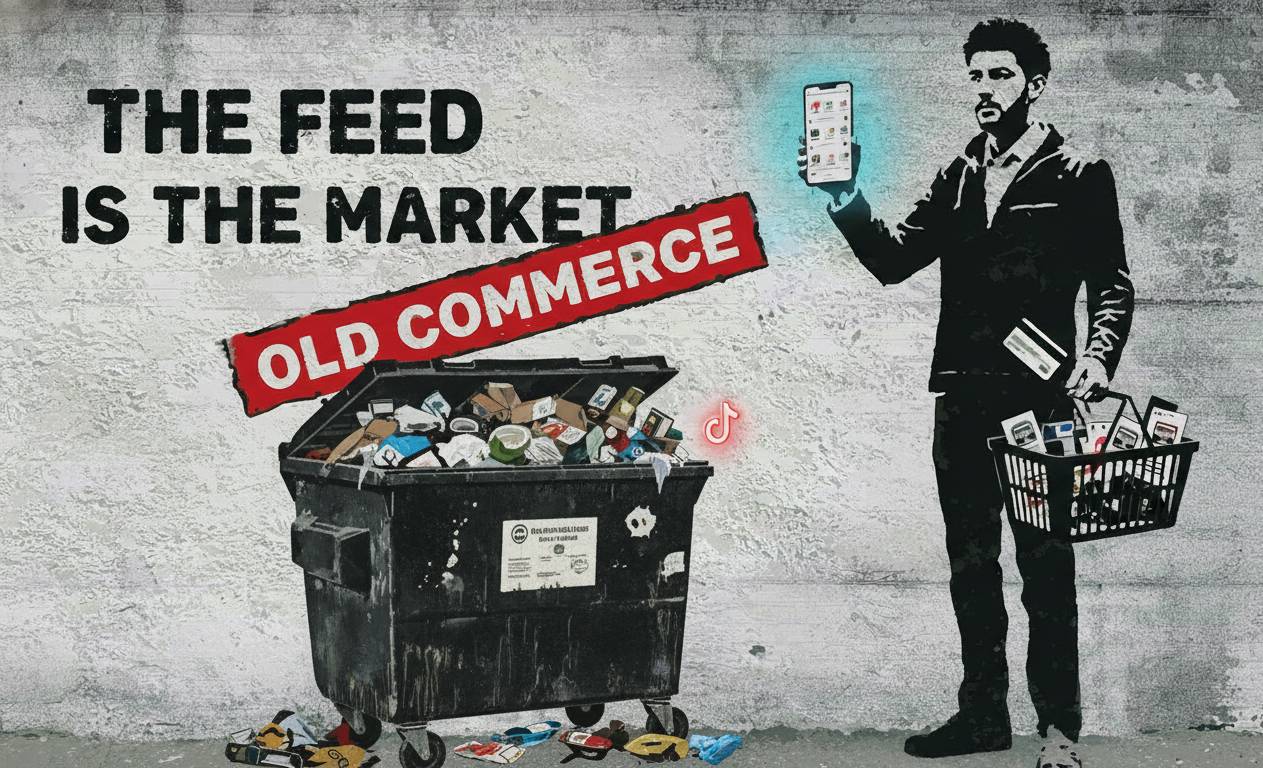
If ecommerce used to be a neatly staged play - marketing on one side, checkout on the other - TikTok Shop is turning it into improv performed in a single room. The room is the For You feed. The props are short videos, livestreams and creators. And the climax is no longer “click through to a website” but “buy now without leaving the scroll.”
That shift sounds incremental until you look at what it does to the underlying economics of retail. When discovery, content and checkout merge into one feed the platform doesn’t just host demand. It manufactures intent, closes the transaction loop and learns from every micro-signal along the way.
TikTok calls this “discovery e-commerce”: scrolling becomes a personalized shopping aisle, and purchase happens where inspiration strikes. In TikTok’s own articulation shoppers discover products through shoppable videos, interactive live streams and a marketplace then purchase without leaving the app.
Europe is where this model is now being tested at scale under real-world regulatory constraints. TikTok Shop’s rollout across the region (UK first, then Ireland and Spain in late 2024, then Germany/France/Italy in March 2025) is not ancient history - it’s a fresh enough deployment that you can still watch behaviors forming in near real time.
Germany offers the sharpest lens because you can combine macro adoption surveys with transaction-based panel data.
A representative Bitkom survey reports that 29% of German internet users buy “on or via” social networks - either through integrated buying functions (explicitly mentioning TikTok Shop and Facebook Marketplace) or through redirects to external online shops. Bitkom also gives platform-level penetration: Instagram (15%), Facebook (14%), YouTube (11%), TikTok (8%) and smaller shares for Pinterest and Snapchat.
That is the demand-side baseline: social commerce is already normal behavior for a meaningful minority and TikTok is a significant - but not yet dominant - purchase platform in Germany by that specific survey metric.
Now overlay what happens when you add in-app checkout and a commerce-native creator ecosystem.
NielsenIQ (NIQ) using its German ecommerce panel reports that about six months after TikTok Shop entered the German market 10.5% of tracked online shoppers had made at least one purchase on TikTok Shop and by March 2026 this had risen to “just over” 15%.
This is why the “quietly becoming major” framing is plausible: it isn’t just that TikTok drives traffic; it is increasingly where transactions happen, enough to show up in retailer rankings. NIQ reports TikTok Shop hit #24 among online retailers after ~28 weeks and #15 at the one-year mark in its measured set.

But the part that should matter most to marketing and retail leaders isn’t the rank - it’s the behavioral pattern.
Feed-native commerce tends to look like this: low friction, low hesitation, repeatable “small wins.”
NIQ’s Germany release describes purchases often sparked directly in the video feed with relatively small baskets consistent with impulse-leaning behavior and a product experience optimized for quick decisions and easy completion. And notably, NIQ reports repeat buying is rising: purchase frequency increased from 2.3 in October 2025 to 3.3 in recent months.
This is the “one-feed” flywheel:
the algorithm finds you a product you didn’t search for,
content makes it feel relevant (and trustworthy),
checkout removes the final barrier,
and the same feed supplies the next trigger.
TikTok’s feature set is explicitly designed around that flywheel. Its Ireland launch announcement lists LIVE Shopping (real-time demos + Q&A), shoppable videos in For You feeds with Product Detail Pages, product showcases on profiles, affiliate-style creator programs, Shop Ads and in-app checkout supported via third-party payment providers.
This is also why the model can outmaneuver traditional performance marketing. In classic ecommerce every step is a leakage point: clickouts, slow product pages, form-fill friction, payment failures and “I’ll buy later” abandonment. TikTok compresses those steps into a single behavioral environment where the platform can continuously optimize to purchase signals.
That closed loop changes what measurement means.
When checkout sits on a brand’s website the retailer owns most of the funnel data - site analytics, cart behavior, customer identity and post-purchase CRM. When checkout sits inside a platform the platform owns the conversion graph and the retailer becomes one actor inside it. TikTok’s own commerce messaging emphasizes “buy without leaving the app" and its ad roadmap shows ongoing investment in commerce-native experiences (for example in-app Amazon purchasing experiences via TikTok ads in certain contexts). For retail leaders the strategic question becomes: are you comfortable turning a portion of your demand generation and conversion into “platform capital” rather than “brand capital”?
In Germany TikTok’s own one-year newsroom statement suggests many sellers are answering yes - at least experimentally. TikTok reports over 25,000 sellers on its German TikTok Shop and claims sellers’ average daily revenues have nearly doubled over the last six months. It also claims that sellers generate on average about 60% of their TikTok Shop revenue through shoppable videos and live shopping formats (with leading global players up to 70%).
This is an operationally significant claim. It implies that on TikTok Shop “content” is not a supporting asset. It is the primary sales surface. That has consequences for how you staff and budget.
A TikTok-Shop-native operating model often needs:
This is where Europe differs sharply from the “move fast” narrative that sometimes dominates social commerce commentary. The one-feed model collides with European governance in three major ways:
- Marketplace due diligence and trader traceability.A 2025 vzbv study examining TikTok Shop’s DSA obligations reports missing or unclear trader information and incomplete mandatory disclosures across tested product pages,arguing that while the platform may collect trader details during onboarding it doesn’t always present them clearly to consumers.
- Ad transparency and influencer commerce.In December 2025 the European Commission announced it accepted TikTok commitments on advertising transparency under the Digital Services Act including improvements to ad repositories and targeting transparency. That matters in a world where Shop Ads, creator promotions and native checkout blur lines between content and commerce.
- Addictive design scrutiny.In February 2026 the European Commission preliminarily found TikTok in breach of the DSA for “addictive design" citing features such as infinite scroll, autoplay, notifications and personalized recommender systems. If “shopping” is increasingly an activity performed inside that engagement architecture, regulators will treat commerce outcomes as intertwined with platform design.
There is also the privacy layer. In May 2025 Ireland’s Data Protection Commission fined TikTok €530 million and ordered corrective measures related to GDPR compliance and transparency in connection with transfers of EEA user data to China. Retailers don’t control that risk but they may inherit its trust consequences.
Now, consider the competitive landscape. TikTok isn’t competing in a vacuum. It is competing against two incumbent logics:
marketplaces (Amazon, OTTO, Zalando) where shopping is intentional and often search-led, and
social platforms whose commerce tools often still hand off checkout to websites.
In Europe a key differentiator is where checkout happens. Meta’s business documentation says that as of September 2025, Shops on Facebook and Instagram use website checkout explicitly pushing transactions back to merchant sites. TikTok Shop is designed to keep checkout in-app.
This matters for measurement and margin:
Website checkout tends to preserve CRM ownership and reduce platform dependency, but can increase funnel friction.
In-app checkout tends to increase conversion efficiency but shifts power, data and policy coupling toward the platform.
Meanwhile, Germany’s ecommerce market is already marketplace-heavy. HDE’s Online Monitor 2025 (with IFH Köln) reports €88.8bn net ecommerce revenue in 2024 and that marketplaces collectively represent 57% of German online commerce. TikTok Shop’s ambition is effectively to become another marketplace layer - one powered by content rather than search.
The economic maturity story shows up in fees. Multiple sources report TikTok Shop raised commissions in the EU5 to 9% starting January 8 2026, quoting TikTok positioning this as part of building a “marketplace of the future.” While official policy details are referenced to the Seller Center (which is not readable in this environment) the change is consistently reported across multiple independent trade outlets.
For merchants that shift is the line between experimentation and commitment. In a low-fee phase you can treat TikTok Shop like bonus revenue: list products, seed creators, see what goes viral. In a higher-fee phase TikTok Shop becomes a real channel with real unit economics: commission, ad spend, creator payouts, and cost-to-serve, all under EU consumer rules on returns and product transparency.

So what happens when discovery, content and checkout merge?
A practical synthesis, grounded in the Europe/Germany signals looks like this:
For marketing and retail professionals the implication is not “go all in on TikTok Shop.” It is to treat TikTok Shop as a new retail primitive: a channel where the creative unit (video + creator) is the storefront and where the best-performing brands will look less like advertisers and more like broadcasters with supply chains.
Germany’s early data points - ~15% of online shoppers having purchased at least once, rising repeat frequency, multi-category revenue mix and rapid seller ecosystem growth - suggest this primitive is already moving beyond novelty.
Winning in the feed means operating like the feed
In the next phase, the winners in Europe are unlikely to be the brands that merely “show up” with a catalog. They will be the ones that operationalize the feed:
content velocity that matches the platform,
creator partnerships treated as distribution,
unit economics that survive higher commissions,
and compliance/consumer trust treated as conversion infrastructure.
That is what it means when discovery, content and checkout merge into one feed: the feed stops being media and becomes the market.