Creators Didn't Kill Retail. They Killed Search.
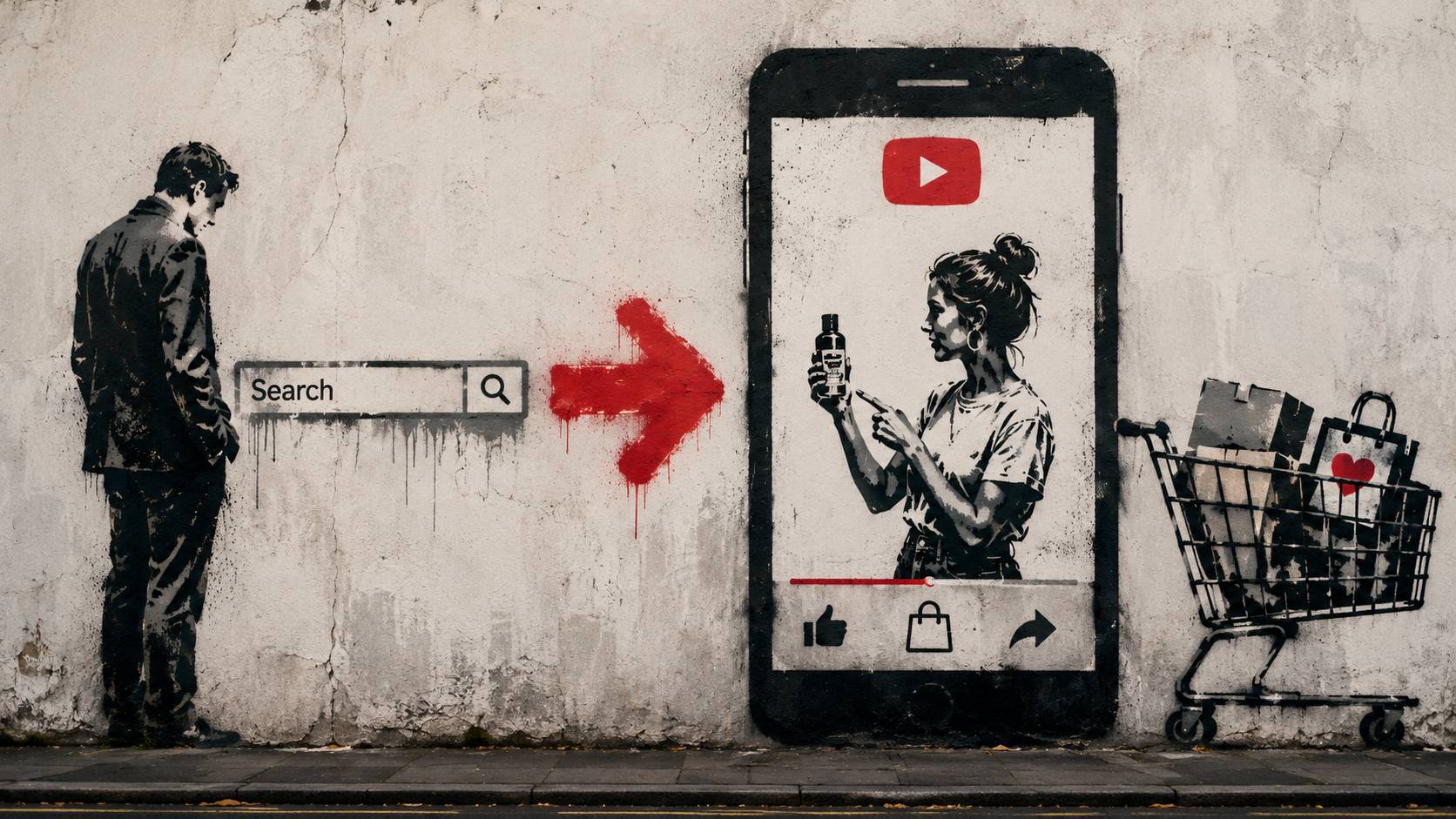
If you want to understand where online shopping is heading stop asking whether YouTube is turning into Amazon. That is the wrong comparison. The better question is whether YouTube is becoming a new kind of search engine - one powered by creators, taste, trust and video rather than by links, keywords and product feeds alone. The UK launch of YouTube's Shopping Affiliate Programme on 23 July 2026 makes that shift much harder to ignore. Eligible creators will be able to tag products from retailers including Boots, Currys, Debenhams, Etsy, Marks & Spencer, Next and Wayfair and viewers can move from a creator recommendation to a retailer checkout with much less friction than before. But the most revealing part is what does not happen on YouTube: the retailer still owns the product page, the basket, the payment page, the fulfillment and the returns. That is why creators are not replacing stores. They are replacing the part of the journey that used to belong to search.
For years the default shopping journey online ran through a fairly stable sequence. You became aware of a need. You searched for options on Google. You compared prices, specs and reviews. You maybe clicked into a blog or a publisher’s “best of” list. Then you landed on a retailer site and bought. Search engines did not just serve results; they served as the main interface of confidence. When you did not know what running shoe to buy, which serum actually worked or whether a £300 air fryer was worth it search was where you went to reduce uncertainty. Google Shopping's own product materials still reflect that model: it is designed to make it easy for users to research purchases, compare different products, and move toward a merchant’s site with structured information such as price, availability, and reviews. That remains a powerful system. But it is no longer the only one.
People still need answers. They've just changed where they look.
What has changed is not that people suddenly stopped needing information. It is that they increasingly want different kinds of information. They want demonstration, not just description. They want context, not just attributes. They want a human being to tell them whether a product is genuinely useful, flattering, durable, hype-worthy or overrated. That is why creator-led commerce is so important. YouTube's own shopping and trends research shows that younger viewers increasingly discover products through creators and content communities and Google's Think with Google research says YouTube is the No. 1 choice for product reviews and product information with creators shortening the average online-video shopping journey by six days. That is not a small optimization. It is a sign that video recommendation is beginning to absorb work that search used to perform.
The most interesting part of YouTube's strategy is that it does not depend on turning every video into a flashy impulse-buying feed. In fact, YouTube’s advantage may lie in being less like TikTok Shop, not more. TikTok Shop is built for embedded, high-velocity, highly in-app commerce: the content, creator, storefront and checkout all live inside the same engine. It is brilliant for impulse categories and for products that benefit from rapid creator iteration. But YouTube's strength has always been different. It is where people go when they want to watch a twenty-minute review, a side-by-side comparison, a tutorial, a haul with actual explanation, a “best camera for beginners” breakdown or a “Top 5 living room essentials” short that still feels like a real opinion rather than a transaction trap. That longer, more deliberate information layer is exactly where search has historically dominated. And it is precisely where YouTube creators are strongest.

Why this shift matters now more than ever
That is also why the timing matters. In March 2026 YouTube lowered Shopping affiliate access to creators in YPP with 500 subscribers in supported markets after having started in 2023 with a much higher U.S.-only threshold for affiliate eligibility. This is not just a monetization tweak. It signals that YouTube wants shopping to become a normal part of the creator journey early, not a premium feature reserved for large channels. A skincare creator with 2,000 loyal subscribers, a menswear creator with 800 subscribers or a kitchen reviewer with 1,500 subscribers can be commercially meaningful even if they are nowhere near entertainment-scale fame. That is the same logic that has long powered affiliate publishing on the open web: niche trust converts. YouTube is simply moving that economic model into its native product layer.
The UK rollout makes that economic repositioning especially significant because Britain is already a live battlefield for social commerce. EMARKETER forecasts £11.75 billion in UK social commerce sales in 2026. TikTok Shop says it already has more than 200,000 active sellers in the UK. MikMak says the UK is the largest social-commerce market in Europe. So YouTube is not launching into a conceptual future; it is launching into a present-tense market where retailers have experienced enough creator-led commerce to know it can drive measurable sales. The question is not whether commerce through content works. The question is which platform gets to own the discovery layer and on which terms. YouTube's answer is that discovery should remain creator-led, trust-heavy and closely connected to Google’s merchant infrastructure.
Retailer behavior already suggests that large brands see YouTube as more than a media buy. Marks & Spencer had been moving into shoppable, personality-led video before the UK affiliate launch ever arrived. Its official communications described a broader social-first strategy said YouTube spend was up 67% in the key holiday quarter and linked its “Love That” programming to a wider effort to drive online growth. Boots, in a public launch-day statement from a senior executive, described the new YouTube partnership as a way of helping more customers discover products they already love. These are revealing statements because they show retailers thinking about YouTube as a hybrid of brand, media and commerce infrastructure. It is not just upper-funnel storytelling. It is discovery architecture.
The partnership reveals a strategy far bigger than shopping
The Google connection makes the strategic picture even sharper. Merchant Center free listings can already surface across Search, Maps, Gemini, YouTube, the Shopping tab, Images and Lens. That means the same commercial data spine is increasingly being used across both query-led and content-led environments. Historically Google Search and Google Shopping captured already-formed or already-articulated intent: someone types “best hiking backpack under £150”, and the system returns candidates. YouTube Shopping is doing something subtly different. It is helping generate the intent before the query ever exists. A creator shows how a backpack fits, what the pockets are like, how it feels after twelve miles and what went wrong with the last model. Suddenly the discovery moment happens inside video, often before the shopper has a clean search term in mind. Search has not disappeared but its monopoly over product discovery weakens.
This is where the phrase “creators are replacing search engines” becomes useful. It does not mean search goes away. Search will still dominate price comparison, near-term replenishment, transactional intent and highly specific lookups. If you already know the exact running shoe SKU you want, or you are checking whether a retailer has it in stock, classic search and retail search remain unbeatable. But discovery is different. Discovery is emotional, social, demonstrative and contextual. Discovery asks: What should I care about? What should I ignore? What is actually worth buying? Those are increasingly creator questions. And because creators answer them with a face, an opinion and a recognizable style they collapse the trust gap that a search result often leaves open. Search returns possibilities. Creators increasingly return decisions.

Creator commerce solves discovery. It doesn't solve credibility.
That does not make creator commerce automatically trustworthy. In fact, its success depends on avoiding the thing that could weaken it fastest: over-commercialization. Regulators already understand the risk. The FTC requires clear disclosure of material connections in endorsements. In the UK the ASA and CMA require affiliate relationships and other incentives to be disclosed promptly and prominently. YouTube itself requires disclosure for paid promotions and tells creators to be transparent when earning commissions. These rules matter not just legally but economically. The second the audience feels that every recommendation is optimized for payout rather than usefulness the creator loses the one asset that search engines and retailers cannot manufacture at scale: perceived authenticity. That is why YouTube's shopping future depends as much on restraint and disclosure as on tooling and checkout design.
There is another reason YouTube's model is powerful: it scales across formats and screens in a way that very few commerce systems do. YouTube has been building shopping features not only for standard videos and Shorts but also for livestreams, collections and TV experiences. It has added bulk-tagging tools, AI-powered tag timing, auto-tagging plans and shoppable connected-TV features. Neal Mohan has said YouTube is focused on “frictionless commerce” and the company has signaled more seamless in-app and TV-side buying flows. That roadmap matters because it suggests YouTube is trying to turn every format into a commerce-capable surface while preserving what makes YouTube compelling in the first place: creators explaining things in depth, in public, over time. The more YouTube can reduce the gap between recommendation and action without making the platform feel like a noisy mall, the more dangerous it becomes to traditional discovery channels.
So what happens next?
The likeliest outcome is not that YouTube “wins ecommerce” in the simplistic sense. Retailers will still need their own sites, their own CRM, their own apps, their own logistics and their own search visibility. But retailers will increasingly have to treat creator networks as the new top of the funnel - and sometimes the new middle of the funnel too. More budget will shift toward creator commerce. More product launches will be designed to be reviewable, demo-friendly and clip-worthy. More shopping journeys will begin with a person instead of a query. And more of the old affiliate web - the SEO listicles, the link farms, the transactional blogs with shallow authority - will get squeezed from both ends by AI on one side and by creators on the other. The store survives. The search box survives. But the first point of trust is moving. On YouTube it is moving toward creators.
That is why YouTube's UK shopping launch should be read as more than a product update. It is a structural signal about how digital commerce is reorganizing. For two decades the internet trained us to think that shopping began with a search engine and ended with a retailer. Increasingly, it begins with a creator and ends with a retailer, with search somewhere in the middle - or sometimes not at all. That is a much bigger shift than “video gets shoppable”. It means the new battle is not just over where transactions close but over who gets to form intent before the transaction begins. On that battlefield creators are not replacing stores. They are replacing the search engines that used to decide what shoppers saw first.