The Buy Box Was Never Yours
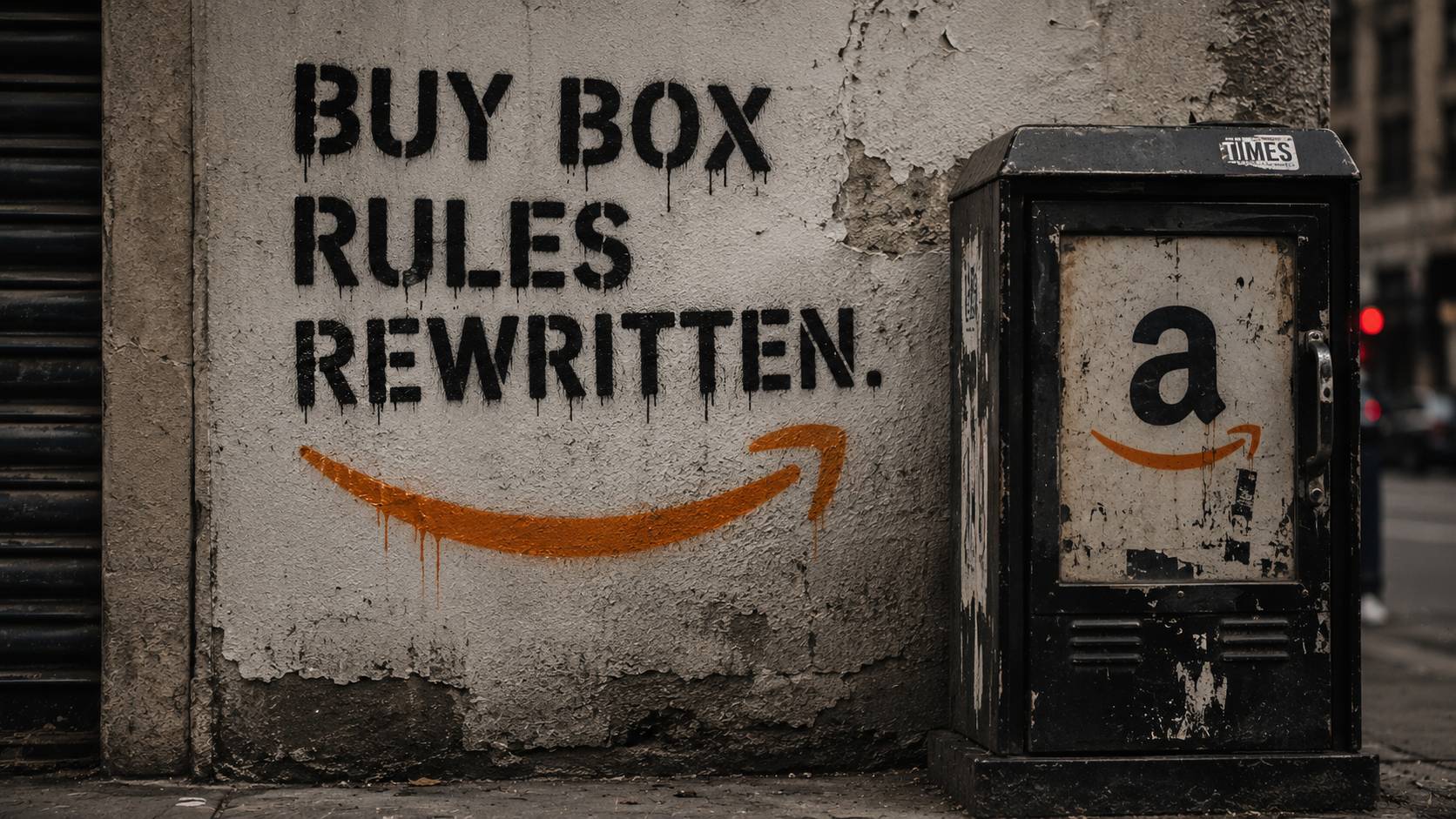
Amazon just changed one of the most important rules in marketplace commerce and it did it in the most Amazon way possible: quietly, inside Seller Central, with language calm enough that a lot of sellers will skim past it and assume nothing fundamental happened. But something fundamental did happen. In July 2026 Amazon said it would begin removing the seller-eligibility requirements for the Featured Offer, the placement most sellers still call the Buy Box, and it would do so globally in waves through the end of the year. For EU and UK sellers Amazon separately pinned the change to 20 July 2026. That is not a cosmetic tweak. It is a change to who gets to compete for the most valuable piece of real estate on an Amazon product page.
To see why this matters you have to understand how the old system worked. Before this update Amazon effectively ran a two-step process. In the first step sellers had to pass an eligibility screen. In the second step Amazon ranked the qualifying offers and selected the Featured Offer winner. That old structure is not just seller folklore; the UK Competition and Markets Authority documented it directly saying Amazon first used a qualification process and then a weighted algorithm in which offer attributes such as price and delivery speed were assigned weights. So when Amazon now says it is removing the first step that means the contest itself is changing,even if the final decision criteria remain familiar.
That last part is where many sellers will misread the announcement. Amazon did not say seller performance no longer matters. In fact Amazon said almost the opposite: it said the Featured Offer will still be selected based on the criteria most important to customers, naming competitive pricing, delivery speed, and performance. So the internal logic has not become easier or looser. It has become broader. More offers now get into the competition and once they are in, Amazon still decides who deserves the button. The gate is going away. The ranking fight is not.
If you sell on Amazon that distinction is everything. Under the old system lots of sellers took comfort in eligibility as a kind of protective moat. They knew some competitors were present on the listing but they also assumed those competitors were unlikely to contend for the Featured Offer because they were blocked upstream by account-health or merchant-quality rules. The 2026 update weakens that comfort. Now those offers can enter consideration as the rollout reaches their account or marketplace. That means your Buy Box share can fall even if you did nothing wrong. The market around you simply got more crowded. That is why several early explainers on the change recommend pulling your 30-day Buy Box share immediately and re-baselining your repricing rules. Past win rates no longer describe the same battlefield.
This is also why the phrase “Amazon quietly rewrote the Buy Box rules” is more accurate than it sounds. Amazon did not publish a splashy formula or a big roadshow deck. It posted the change in Seller Central News and Announcements and told sellers no action was required. That wording is technically true but strategically misleading if taken too literally. No action is required to be included. Action is absolutely required if you want to keep the Buy Box on competitive listings after the inclusion pool gets wider.

So what does Amazon seem to be weighing now?
Publicly Amazon still points sellers toward the same major pillars: competitive total price, faster and free shipping, good customer service and in-stock inventory. Amazon moderators add more texture than most sellers realize. In forum guidance, Amazon staff have explicitly said that order volume, chargeback rate, and complaints visible through the Voice of the Customer dashboard are evaluated. That is a big clue. It suggests that Amazon does not think about the Buy Box as just price plus Prime. It thinks about the Buy Box as a customer-outcome prediction engine. The seller most likely to deliver a low-friction order at an acceptable price gets the best shot at the button.
That also explains why so many sellers misunderstand price. Yes, price matters. A lot. But Amazon has long evaluated item price plus shipping, not just the number you put in the price field. And pricing competitiveness is still tied to Featured Offer health in Amazon’s pricing systems. At the same time Feedvisor’s current guidance is right to warn sellers that the lowest price is not automatically the winning price. A faster or more reliable seller can still win slightly above the lowest offer. In plain English: if your competitor has worse shipping, shakier tracking, weaker inventory or more customer issues you may not need to be cheapest to win - but you do need to be close enough that Amazon sees your offer as the better customer outcome.
For FBA sellers, the update is a mixed bag. The good news is that FBA still aligns well with what Amazon says it values: fast delivery, predictable operations, tighter promise windows and fewer avoidable service failures. The bad news is that the structural protection around that advantage is weaker if more offers now get admitted into the contest. Historically industry analysts have argued that Amazon’s Buy Box preferred Amazon retail first, FBA sellers second and merchant-fulfilled sellers afterward because Amazon trusts warehouse-controlled logistics more than self-fulfilled logistics. That logic still mostly holds at the customer-experience level. But it no longer means that weak offers always get screened out before they can challenge you.
For FBM sellers, though, this change could be the most interesting shift in years. Amazon has already spent the last few years, especially under UK and EU regulatory scrutiny, moving toward a formal position that the Prime badge itself should not be a criterion in Featured Offer selection in those markets. Amazon told UK sellers that Prime eligibility and the Prime badge would no longer be criteria there while also saying that fast and free delivery remain relevant because customers care about them. That is a subtle but meaningful distinction. It means Amazon is trying to say: “We are not awarding the Buy Box to the badge; we are awarding it to the delivery outcome”. If you are an FBM or SFP seller who can produce the same delivery experience that matters.
Seller Fulfilled Prime operators need to read that especially carefully. SFP can still be a powerful bridge between self-fulfillment and Amazon-like delivery performance but the published bar is high: 93.5% on-time delivery, 99% valid tracking and seller cancellations at or below 0.5%. That is not a casual standard. Still, if the market is moving away from badge-based protection and toward direct delivery-performance competition strong SFP operators could be among the biggest beneficiaries of Amazon’s quiet rewrite.
What about new sellers?
This is where the change is promising but not magical. Historically seller guidance, support responses and community experience all pointed in the same direction: you needed a Professional account, a decent sales history and enough trust signals for Amazon to let you into the game. New sellers in the forums routinely complained about being unable to win or even qualify, sometimes despite having competitive prices. With the eligibility gate being removed, consideration should become easier. But easier consideration does not mean faster rotation. If you are new and you have no selling history, weak feedback density, slow delivery or thin stock,you can still be considered and still lose. The wall might be lower; the race is still uphill.
If you want a sense of how painful Buy Box shifts can be the seller forums are full of examples. One seller said that when ODR rose above 1%, daily sales dropped from roughly 40 - 60 units to 8 - 11. Another said losing the Featured Offer on an established listing cost about $45,000 in a month. And another seller, in a more subtle but equally revealing case, said competitors on a branded listing were taking more than 90% of the Buy Box and sales while they captured just 3 - 5%, even though all offers were FBA, all prices were aligned and the seller believed their metrics were equal or better. Those are not controlled experiments. But they are exactly the sort of operational evidence that tells you the Buy Box is not a side metric. It is a demand-distribution engine.
And because the Buy Box captures so much purchase activity even modest rotation losses can get expensive fast. Amazon told the CMA that over 75% of purchases on the UK marketplace were made through the Featured Offer. Feedvisor says more than 80% of Amazon’s total sales occur there and Jungle Scout puts the broader range at roughly 80% to 90%. So when your Featured Offer share slips the hit is not linear in the way many sellers hope. If the default one-click path moves away from your offer conversion usually goes with it. Amazon’s own metric defines Featured Offer percentage as the share of page views where your offer held the placement. That turns Buy Box monitoring into a direct revenue discipline, not just a listing-health curiosity.

So what should sellers do now?
First stop asking whether a SKU is “eligible” and start asking how much Featured Offer share it actually owns. Eligibility is fading as the main story. Rotation is the story now. Pull your ASIN-level Buy Box percentages and compare them before and after the 2026 rollout reaches your account. That is your first signal that the pool has changed.
Second, rework your repricing logic. If your current price floor assumes that certain weak competitors were effectively dead offers your floor may now be too high for the new field. But do not panic and race to the bottom. Amazon still rewards the best overall customer outcome, not just the rock-bottom number, and Feedvisor’s analysis is right that blindly matching the lowest offer can wreck margin without improving win rate. Reprice around contribution margin, delivery competitiveness and Buy Box probability - not fear.
Third, become obsessive about delivery promise quality. Amazon’s visible guidance keeps returning to the same point: faster shipping, free shipping and tighter delivery windows increase your odds. That means carrier mix, same-day handling on relevant SKUs, realistic cutoffs and clean tracking feeds are now Buy Box levers, not just fulfillment hygiene.
Fourth, monitor complaint signals at the ASIN level, not just account-wide. Voice of the Customer complaints, ODR components and chargebacks are all telling Amazon something about how customers experience your offer. A catalog-wide green account can still hide a few toxic ASINs that drag down your outcomes right where the Buy Box is fought.
Fifth, keep stock deeper on the listings that matter most. Amazon repeatedly points sellers toward inventory availability as a Featured Offer factor. If you run shallow or inconsistent FBA stock or leave FBM lead times drifting because replenishment is loose you are handing away score in a contest that just got more crowded.
And sixth, if you run ads remember the nasty second-order effect: on many listing types, sellers who do not control the Buy Box cannot run sponsored ads for that product. Jungle Scout highlights this clearly. So Buy Box losses do not just cost organic one-click conversion. They can also cut off paid growth levers and make ad performance look worse than it “should”. A lot of sellers will think they have a PPC problem in the second half of 2026 when what they really have is a Featured Offer share problem.
That is the real lesson in Amazon’s quiet change. The old game let sellers obsess over whether they had crossed a threshold. The new game forces them to manage a live score. The threshold still exists in other parts of account health, pricing health and shipping compliance but the Featured Offer itself is moving toward a more continuous competition. More offers. More volatility. Less room to assume that yesterday’s protected margin will survive tomorrow’s rotation.
Amazon did not remove the Buy Box game. It made the game wider, noisier and more operational. Most sellers have not noticed yet. The ones who do notice first - and recalibrate price, delivery, inventory and complaint control before the wider pool starts biting - will have the edge.