Amazon Bought the Hype. Everyone Else Sold the Goods.
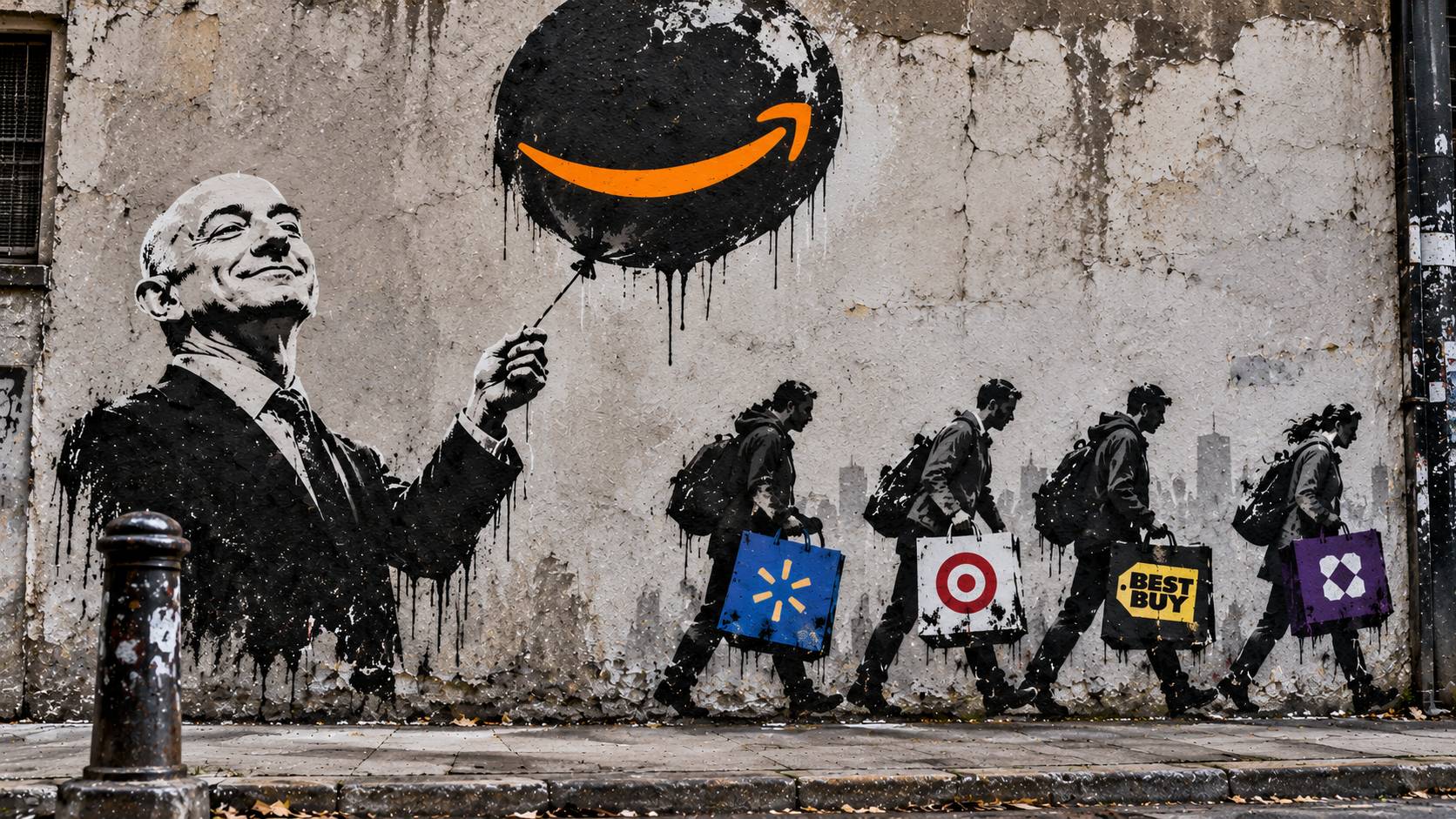
There is a revealing way to look at Amazon’s Prime Big Deal Days. Ignore Amazon for a moment. Look instead at Walmart which surrounded the October 6 - 7 2026 Amazon event with a week-long sale. Look at Target which scheduled its own Circle Deal Days for the exact same two days. Look at Best Buy discounting electronics, Wayfair discounting furniture and home goods, Kohl’s pushing promotions and deal sites publishing giant comparison guides showing shoppers where the lowest price could be found.
Then look at the number: $9.86 billion.
That is how much U.S. consumers spent online during Amazon’s two-day October event window in 2026 according to Adobe Analytics - an 8.5% increase from the previous year. In 2025 the corresponding total was $9.09 billion.
But here is the crucial part: those are not Amazon sales.
They are U.S. online-retail sales across Adobe’s measurement universe. Adobe analyzes direct transactions using a dataset encompassing more than one trillion visits to U.S. retail sites, around 100 million products and 18 product categories.
That distinction turns what might look like a story about one retailer’s sale into something much more interesting.
Amazon has created a shopping holiday
Not an official holiday obviously. Nobody gets October Prime Day off work. There are no greeting cards. But in commercial terms, it increasingly behaves the way Black Friday behaves: consumers expect discounts, retailers coordinate promotions, media outlets publish shopping guides, brands prepare inventory and advertising campaigns and billions of dollars of purchases become concentrated in a predictable window.
And the remarkable thing is that Amazon’s competitors can profit from the occasion without having paid the original cost of inventing it.
Amazon has been working on this trick for more than a decade. The original Prime Day arrived in July 2015 as an anniversary event and membership benefit. In 2022 Amazon deliberately expanded the model into the fall with the Prime Early Access Sale, a new 48-hour October promotion designed to kick off holiday shopping. It offered a Top 100 list, rotating deals, gift guides and discounts across categories from electronics to toys.
By 2025 the event was firmly established as Prime Big Deal Days. Amazon explicitly described the October 7–8 sale as the beginning of the holiday-shopping season. In 2026 it returned on October 6–7.
Amazon has become very good at manufacturing urgency around those 48 hours.
In 2026 Prime membership was the gatekeeper to the central deals. New featured offers dropped three times a day. Alexa could notify customers when something on a list - or in a category Amazon believed they cared about - became discounted. Amazon promoted millions of deals across more than 35 categories and advertised reductions of 45% or more on some featured brands.
That is an elegantly constructed shopping machine.
The membership requirement says: “You belong to the club”. The two-day deadline says: “You cannot postpone the decision indefinitely”. Rotating deals say: “Come back again”. Personalized alerts say: “Something you wanted is cheaper right now”.
And around that machine sits Amazon’s enormous marketing apparatus. The company reported $23.5 billion of advertising and other promotional expense in 2025 versus $21.4 billion in 2024. That number is global and company-wide - it emphatically is not a Prime Big Deal Days budget - but it gives some sense of the marketing infrastructure supporting the broader Amazon ecosystem. Amazon says it uses sponsored search, third-party referrals, social and online advertising, television and other traffic channels. Its Associates program adds tens of thousands of creators and publishers who can earn commissions for sending shoppers to Amazon.
There is no public accounting that tells us how many dollars Amazon spent to make October 6 - 7 matter.
In one sense, though, that is precisely the point. Once an event becomes established the rest of the market starts doing some of the promotional work for you.

Consider Walmart
Its 2026 Deals & More event began October 5, one day before Amazon, and continued through October 11. Walmart advertised discounts reaching 50% on home products, 40% on technology and fashion and 30% on toys. Unlike Amazon’s main Prime deals the sale did not require a paid membership.
Target went further: Circle Deal Days landed on October 6 and 7 - the same dates as Amazon - with early access for some Circle members the day before. Best Buy ran Techtober. Wayfair had five days of deals.
This is what it looks like when a proprietary event escapes its owner.
Consumers do not wake up thinking: “I must maximize Amazon’s return on its marketing investment”. They wake up thinking: “Apparently everything is on sale this week. Let me compare prices”.
And compare they do.
Numerator found that 55% of 2026 Prime Big Deal Days buyers compared products or prices somewhere else before purchasing from Amazon. Among those shoppers 66% checked Walmart, 40% checked Target and 27% checked Costco or Sam’s Club.
The most striking evidence comes from the previous year. During the two days of Amazon’s 2025 fall event, Amazon shoppers also spent nearly $400 million at Walmart.com and Target.com, according to Numerator. That was a 67% jump from the prior week.
Think about the economics of that for a second.
Amazon spent years teaching consumers that a particular period is a time to hunt for bargains. It built the Prime brand, trained shoppers to expect giant sale events, developed fulfillment capacity, recruited sellers, advertised Prime membership and encouraged publishers to cover its deals.
Then an Amazon customer, primed to shop, opens another tab and buys the product from Walmart. For Walmart that transaction is a form of spillover. Amazon helped generate the occasion; Walmart captured the purchase.
Of course calling it “free money” would be wrong. Walmart still has to discount the product, advertise its own sale, stock the inventory, process the payment and deliver the order. Target faces the same costs. A rival may avoid the historical expense of inventing the shopping occasion, but it does not avoid the cost of competing for the customer once the occasion exists.
That distinction becomes especially important when we talk about revenue versus profit.
Adobe found that discounts across its tracked market peaked around 20% off listed prices during the 2026 event with particularly strong reductions in categories such as computers, televisions, electronics, toys and clothing. Retailers’ individual advertisements sometimes promised much larger “up to” reductions. A big markdown can generate impressive sales growth while producing much less impressive profit growth.
Who pays for the discount? Sometimes the retailer. Sometimes the manufacturer. On a marketplace the seller may absorb some or all of it. A promotion may improve inventory turnover and reduce the cost of carrying excess stock. Or it may simply convince somebody to buy in October the same product they would otherwise have purchased at full price in November.
The public data cannot untangle all of those effects. What they can show is that shoppers were intensely value-conscious.
Seventy-four percent of 2026 Prime Big Deal Days shoppers said inflation influenced their participation according to Numerator. And the popular purchases were hardly a catalogue of extravagant Christmas presents. Protein shakes. Lysol wipes. Scott toilet paper. Dawn Powerwash. Sixty-eight percent of Amazon items bought during the event cost less than $20,while only 2% exceeded $100.
In other words October Prime Day has partly become a giant household restocking event.

But there is another side to the numbers
Adobe found that the proportion of purchases going to the most expensive products within a category was 21% higher than the year-to-date norm. In electronics that premium-product effect was 45% higher.
That makes intuitive sense. A consumer might use the sale to save 20 cents per roll of paper towels. Another might use it to justify moving from the television they could normally afford to the better model that has suddenly fallen into their budget.
Discounting does not only make people buy more. It can change what they buy. And that helps explain why every large retailer increasingly feels compelled to show up.
A retailer that refuses to participate in October may protect its margins - but risks looking expensive during a week when consumers have been trained to compare prices. A retailer that joins the discount battle can protect market share - but risks teaching its customers that the regular price is something only impatient people pay.
This is the classic promotional trap, now scaled to an industry calendar.
There is also a time-shifting problem
Amazon calls the event a holiday kickoff but if shoppers really do start Christmas purchasing in early October some of that money will inevitably come out of later shopping periods. Numerator found that more than one-third of 2026 shoppers had completed at least half of their holiday shopping. The proportion planning to shop on Black Friday was four percentage points lower than in the previous year’s survey while Cyber Monday intent fell five points.
Adobe has put the consequence plainly: October Prime Big Deal Days has changed the shape of the holiday-shopping season creating an extra pre-season demand spike that retailers must now plan around.
So Black Friday is not necessarily dying. It is being surrounded.
The modern U.S. holiday calendar increasingly looks less like one giant November weekend and more like a chain of promotional waves: October sale week, early Black Friday, Black Friday itself, Cyber Monday and the December rush before shipping deadlines.
For retailers that means inventory decisions need to happen earlier. Marketing budgets need to stretch over more promotional periods. Pricing teams need to think harder about how frequently a product can be discounted without destroying price credibility.
For shoppers it means almost constant encouragement to believe that now is an unusually good time to buy.
That makes price comparison more important, not less.
A Washington Post journalist who tracked almost 50 personally purchased products around Amazon’s 2025 event found an average saving of just 0.6% in that particular sample; some products were actually more expensive during the sale. The sample is far too small and non-random to generalize across Amazon’s enormous catalogue, but it is a useful reminder that a bright discount badge is not the same thing as a historically low price.
Consumers appear to understand this better than marketers might like. The majority are cross-shopping.
And therein lies the deepest irony of Amazon’s October holiday.
Every time Target schedules Circle Deal Days against Prime Big Deal Days Target is competing with Amazon.
But Target is also validating Amazon’s calendar.
Every time Walmart publishes a giant October sale it offers shoppers an alternative to Amazon.
But it also tells millions of shoppers that, yes, this is an important week to buy things.
The same is true when Best Buy matches Amazon’s electronics prices, when Wayfair holds a furniture event, when publishers produce “best anti-Prime Day deals” articles or when shoppers open several retailer tabs at once.
Amazon can lose individual transactions while winning the larger battle over consumer habit.
That does not mean the strategy is invulnerable. Regulators are already examining important pieces of Amazon’s broader ecosystem. The FTC and states sued Amazon in 2023 over alleged monopolization practices in online retail and marketplaces. Amazon separately agreed in 2025 to pay $2.5 billion to settle an FTC case concerning Prime enrollment and cancellation practices without admitting wrongdoing. The Prime case is particularly relevant because exclusive shopping events help make membership itself more valuable.
In 2026 regulators also challenged Amazon’s advertising-auction practices alleging that the company improperly increased charges to advertisers; Amazon disputes those allegations. That fight matters to sellers because a major shopping event can require them to fund both discounts and paid visibility inside Amazon’s marketplace.
None of those cases means that creating Prime Big Deal Days is itself illegal or anticompetitive.
What they do underline is how many layers of commerce Amazon now touches: membership, marketplace transactions, fulfillment, advertising, product discovery and, increasingly, the calendar itself.
That last asset may be easy to underestimate.
Retailers have always wanted customers to come to their stores.
Amazon has managed something more ambitious: it has created days when customers feel they should go shopping somewhere.
In 2026 that somewhere generated $9.86 billion of U.S. online spending in 48 hours. Some of it went to Amazon. Some went to Walmart, Target and other competitors.
And that is exactly why Prime Big Deal Days now looks less like an Amazon promotion and more like a genuine shopping holiday.
A mature retail holiday does not require the company that invented it to capture every dollar.
It requires everyone else to organize their calendars around it.