The Store Is Dead. Long Live the Store.
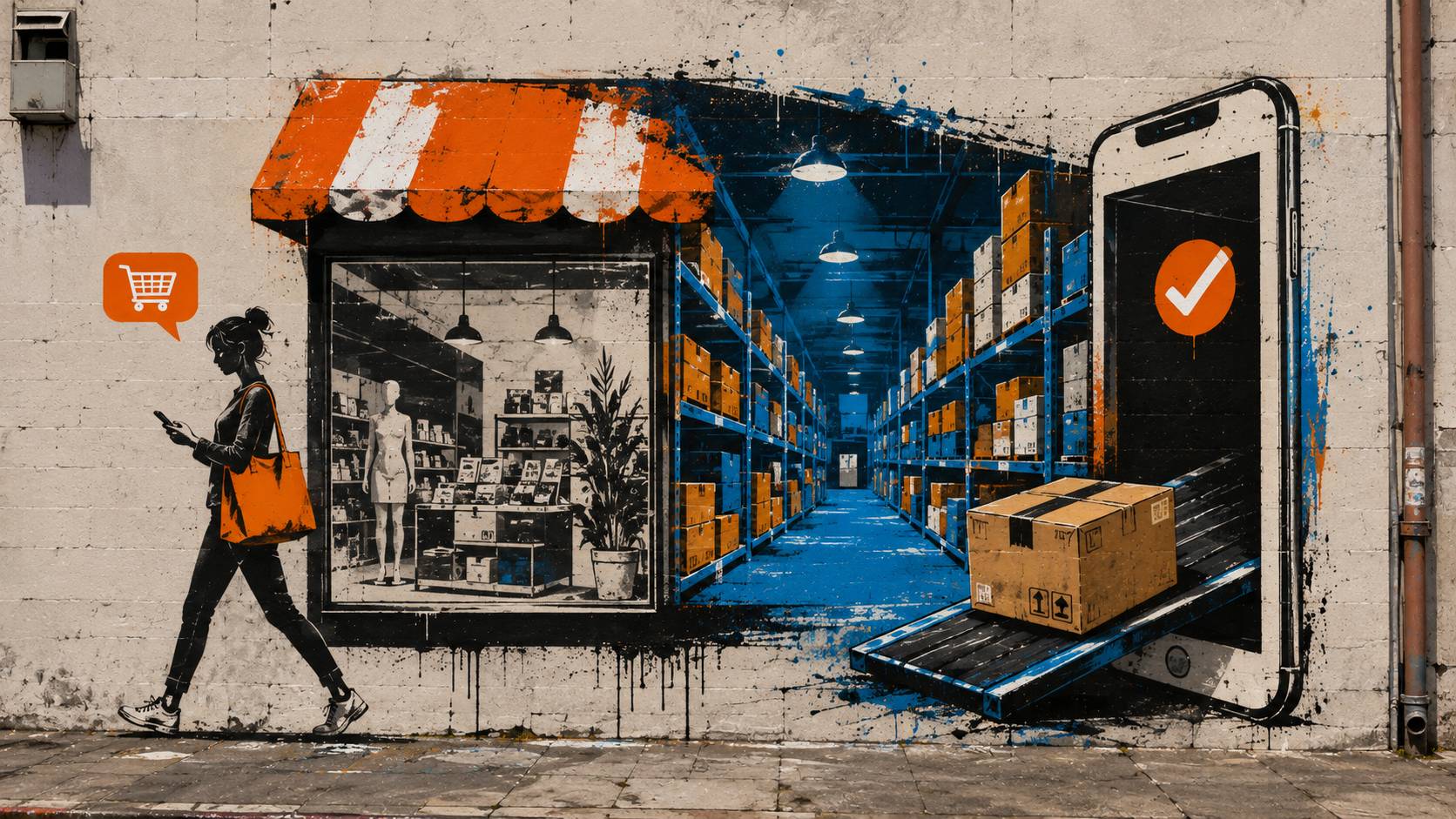
For 25 years e-commerce and brick-and-mortar were portrayed as mortal enemies. Countless headlines declared the “death of retail” imagining a future where warehouses and websites made stores obsolete. Instead, we’re witnessing a great irony: online retailers are coming back home to stores. After pushing shoppers online today’s e-commerce giants are desperately depending on physical shops to win the delivery race.
Think of it this way: e-commerce built its success by offering endless selection and convenience but now it pays a hidden price for scale. Fast shipping isn’t free. A two-day parcel might cost $5–10 to ship and labor eats half of last-mile costs. As customers got hungrier for speed simply building more giant warehouses wasn’t enough (and got outrageously expensive, as Kroger painfully found). The solution turned out to be right in front of us all along: the ubiquitous store.
Stores as the new warehouses
Walk into any Walmart or Target today and you’ll find more than just cereal and socks. Those very store shelves and stockrooms now secretly double as fulfillment centers for online orders. Under fluorescent lights associates pull items off the shelf into red online orders instead of direct-to-cart purchases. Their vans roll out not just with fresh bread but with packages headed miles away. Retail giants now say their stores can deliver to most of the country the same day. For example Walmart recently boasted it can reach 93% of U.S. households with same-day delivery. That power comes from 4,700 supercenters sprawled nationwide, not new warehouses.
Amazon – the company that killed countless retail chains – has followed suit. After years of trial and error in groceries Amazon is integrating Whole Foods and Amazon Fresh stores into its logistics network. A new Whole Foods in Pennsylvania is basically a test lab with a 10,000 sq.ft. automated mini-warehouse inside. You order from Amazon’s app and robots in that store fulfill the order in minutes. In other words Amazon is quietly turning its health-food stores into package depots to get your groceries faster.
Target too, frames its stores as “hubs”. The chain set up a sortation network that batches packages by ZIP code across stores. Its supply-chain boss says this lets a truck load up at multiple Targets and head out for local deliveries, all in one lap. Why go to a distant DC when you can pack orders from the store around the corner? The result: 80% of Target’s online orders can reach customers in one day – unheard-of speeds a few years ago.
This is no accident. Research firm GlobalData found that in 2023 nearly 42% of all online orders involved a store somewhere in the process. One out of every two online purchases went to or through a store, up from just 27% a decade ago. The old narrative – “as e-commerce grows stores become irrelevant” – has flipped. Today the store is very often the heart of the order.

Why it works: speed, cost, convenience
Cost and speed are the magic sauce. Filling an online order from a local store beats shipping from across the country. Retail analysts calculate that using a store to ship can cut fulfillment cost by about 40% compared to a distant warehouse. You own the building, the shelves are already there and instead of paying for a 500-mile haul the driver is at most 5 miles away. Walmart’s finance chief told investors their Q4 delivery costs fell 20% per order just by hitting more houses per stop thanks to store density.
Shoppers don’t just want things cheap, they want them fast. Today’s online customer is famously impatient. In one study 88% of consumers said they’d pay extra for same-day delivery. That’s not a niche demand – it’s nearly everyone. Target’s head of stores openly says customers expect things like: “Buy it now, get it in an hour”. And indeed, quick commerce apps and dark stores promise exactly that. Retailers saw the writing on the wall: if you don’t use your stores to deliver someone else will (think: Instacart’s 30-minute grocery runs).
Leveraging stores gets deliveries done faster. It’s simple geography: your order jumps from a shelf on Elm Street to your doorstep on the same street. Late last year Walmart reported that 30% of its paid delivery orders were for 3-hour or faster windows – all thanks to nearby stores. Even non-food retailers hit the mark: Target says 80% of same-day deliveries are out the door in under 3 hours. Amazon’s answer is to add razor-sharp tools – drones and robot vans – but even those machines still need something to pick up. They’ll likely launch from smartly stocked local sites.
Stores also cut friction. Instead of waiting for a truck consumers can pick up orders on their schedule. And returns – which can easily be 20% of purchases – are cheaper when dropped off at a store than shipped back. Landlords, however, grumble because those returns don’t count as sales muddying how busy a shopping district really is.
New tech in old places
To transform stores into mini-DCs retailers are installing new tech in backrooms and basements. The most dramatic is automated micro-fulfillment. Picture a giant vending machine behind the grocery aisle where robots whiz through bins of shampoo and cereal. That’s real: Walmart is rolling out in-store micro-fulfillment systems (via partners like Alert Innovation and Fabric) in dozens of stores. A worker then grabs those robot-picked items and adds fresh produce by hand. These systems drastically speed up picking high-volume goods and can handle orders for multiple stores at once.
Target’s fix is a little different: it built sortation centers next to stores (or inside a store annex). Here packages from many stores are sorted by zip code automatically. Trucks then take big pallets of orders out for delivery. This crunches down hundreds of one-by-one trips. Target says it’s doubling the next-day packages sent through these hubs in 2023.
Even without robots simply rethinking store layouts helps. Some chains are testing “click-and-collect” lockers outside stores, automated kiosks where pre-packed groceries wait for you to scan and open. Others carve out corner space for online-only inventory, essentially small dark stores that look empty to shoppers but fulfill web orders constantly.
Big players, big moves
- Walmart: Long the king of big-box, Walmart has quietly made its stores the biggest threat to Amazon in last-mile logistics. Last year it reported delivering billions of items via curbside and delivery – often same-day. Its new “APD” strategy turns 65% of stores into automated hubs by 2026. Walmart’s CEO McMillon reminds everyone: “we didn’t build fulfillment centers everywhere – we turned our stores into them.” Indeed, Walmart claims more than half of its online orders ship from local stores now.
- Target: The retailer that famously bet on “cheap chic” is now betting on cheap shipping. By processing 80% of its online volume in stores, Target can often outpace competitors on speed. Its $100M investment in new sortation centers shows how serious it is. Every Target shopper in most of America can get a next-day (or even same-day) delivery with free or low-cost shipping – a luxury that a few years ago only Amazon Prime promised.
- Amazon: If you thought Amazon had no use for storefronts think again. After studying grocery for decades Amazon now acts like a retailer with hundreds of stores (550+ Whole Foods, plus Amazon Fresh, plus local delivery hubs). It’s using stores to extend Prime perks: fresh groceries delivered from Whole Foods, two-hour delivery on popular items in select cities and even Amazon-branded “stores within stores” to grab quick-turn products. Its innovation arms are full of drones and robots but these still need inventory staged nearby. In Amazon’s 2025 shareholder letter Jassy proudly notes that adding perishables to same-day delivery made fresh produce one of the top ten items on-demand. What opened that path? Physical stores stocked like mini-warehouses.
- Kroger & Grocers: By contrast, Kroger’s experiment with massive automated hubs hit turbulence. The company spent $2.6 billion on Ocado robots but saw lackluster returns and in late 2025 began closing those centers. Kroger’s CEO announced a renewed focus on its chain of 2,700 stores and partnerships with Instacart – essentially admitting that local stores are easier to optimize than far-off mega-factories. Other grocers (Albertsons, Ahold, others) are taking a lighter path: building modest micro-fulfillment cells inside stores, usually 10–15k sq.ft., that serve nearby neighborhoods. The goal is to speed up online orders without overspending on greenfield warehouses.
What the Metrics Say
Let's compare how these strategies pay off. Here are some key metrics emerging from retailers and analysts:
- Delivery Coverage: Walmart’s network now covers nearly 93% of U.S. homes with next-day or same-day service. Target similarly hits 80% of ZIP codes with one-day delivery. Amazon, with drones and urban pods, is pushing sub-hour delivery in pilot markets.
- Fulfillment Cost: Turns out local fulfillment saves money. Target points out store fulfillment is 40% cheaper than warehouse fulfillment. Walmart’s margin calculations back this up: by shipping locally, it trimmed last-mile costs 20% in one quarter.
- Order Volume Through Stores: In some cases “nearly all” digital sales flow through stores. GlobalData reports Walmart now ships more than half of its online units from stores, and “nearly all” of Target’s. Albertsons says its micro-fulfillment pilots alone will handle a major share of grocery e-commerce in their zones.
- Delivery Speed: It’s not just marketing hype. Today big retailers routinely promise next-day or faster. Target delivered twice as many next-day orders in 2023 as the year before. Walmart says the vast majority of its orders arrive faster than two days. The consumer has spoken: if you can push products to their door by tomorrow they’ll give you the business.
- Inventory Accuracy: Behind the scenes store integration requires tracking. Many retailers have moved to live inventory systems often tagging items with RFID. Precise data means when an online order hits, the system instantly knows which store (or if multiple stores) can supply it. McKinsey analysts note that bringing inventory closer to customers enables far greater delivery agility. In practice automated pick systems like Takeoff claim over 99% accuracy drastically reducing mis-ships. This saves on costly returns and boosts shopper trust.

Beyond Retail: Bigger Impacts
The rise of store-fulfillment is shaking up the whole ecosystem:
- Real Estate: Retail landlords must rethink malls and shopping centers. A store that doubles as a mini-warehouse changes foot traffic patterns. On one hand a busy pick-up lane means continued rent; on the other landlords fret that easy returns deflate sales-per-sq.ft. The Coldwell Banker real-estate blog notes this paradox: stores doing more business with fewer in-person buyers can “complicate rent rates”. Some property owners are starting to see grocery pickup lockers and e-commerce dock bays as normal features of a “modern” mall.
- Competitors and Partners: Standalone warehousing firms feel the pressure. If every Home Depot becomes a delivery node, do we need another big warehouse? The warehousing boom of the 2010s is shifting. Meanwhile 3PLs that promised to serve retailers are now in-house. Walmart, for instance, is even offering fulfillment to third-party sellers (a rival tactic to Amazon’s Fulfillment by Amazon). At the same time a new logistics turf war brews: UPS and FedEx now compete with Walmart’s in-house fleet for that same street address.
- Consumers: People get faster, cheaper delivery but they might pay in other ways. Dense delivery traffic can clog neighborhoods; there are more vans crisscrossing the morning curb. Some cities are already reacting: local governments in the U.S. and Europe are clamping down on new big e-commerce warehouses and pondering rules for delivery zones. For urban shoppers that could mean restrictions or surcharges on deliveries.
- Labor Markets: More local fulfillment creates jobs but a different kind. Uber drivers and store cashiers may find new roles in warehouse staging and sorting. Retailers like Walmart emphasize that automation helps them reallocate labor to higher-paid tasks. Still store workers must adapt to new tech-driven workflows. Unions in some countries are wary: they see automated stores as a threat to traditional retail jobs. So far the patterns show a re-skilling trend rather than outright cuts, but it's a space to watch.
The Counterarguments
Is this trend all upside? Critics note a few downsides:
- Cannibalization and Focus: Critics in the 2010s argued that pushing shoppers online would cannibalize stores. Now the question is reversed: could over-focusing on delivery hurt the in-store experience? If a store devotes half its staff to packing online orders, will visitors get neglected? Retailers argue that operations are balanced to prevent that. For example many grocers keep fresh and service-heavy departments as “human” jobs, while machines pick the dry goods. The idea is robots do the grunt work so people can do the value-add tasks (like fresh-cut, coffee bars, etc.).
- Investment and Flexibility: Systems built in 2023 might be obsolete in 2030. By then delivery demands (and technologies like AI-guided drones) could have changed again. If a retailer sinks $200 million into a micro-fulfillment machine it needs high throughput to pay off. If omnichannel demand stalls or shifts (as some predict post-pandemic) those investments can become white elephants. Kroger’s OCado exit is a caution: not every fancy robot bet pays off.
- Zoning and Community: Last-mile logistics face local pushback. The same communities that cheered on Amazon warehouses now balk at more trucks. WSJ reports growing NIMBYism around any new fulfillment center. Dark stores (which are basically warehouses labeled as grocery stores) can run afoul of city codes. Retailers are mindful of messaging; many call their operations “omnichannel distribution” rather than “warehousing.” But as consumers we should expect more debates: “do we want a dozen delivery vans outside every store?”
The Ironic Truth
Ultimately the irony is stunning but simple: The very thing e-commerce set out to replace — the local store — has become essential to its future. A century ago stores clustered in towns so people could walk to shop. Now we live in a world where you might never step inside a store but a store still arrives on your doorstep with groceries and gadgets.
We’ve gone from “Amazon kills retail” to “Amazon needs retail to kill delivery time”. Walmart, once the icon of physical retail, is now defending itself with digital agility. Target, once known for design and deals, is now also known for delivery speed. And the companies that only operated online have to become landlords to play the game.
This role reversal has winners and losers. Shoppers win in the short term (faster shipping). Some retailers win by securing urban reach. But others — small offline-only shops or city planners stuck in old zoning — may find the landscape more challenging. The narrative is no longer “store versus web" but “store as part of the web.”
For the next chapter of retail expect two truths to coexist: the mom-and-pop store that customers love for experience and the multi-thousand-square-foot retailer that secretly moonlights as a 21st-century warehouse. The irony of the last 25 years has produced a retail ecosystem where physical and digital are inseparable partners. E-commerce didn’t kill the store; instead, it realized that to survive, it might just need the store more than ever.