The Death of the Discount Festival
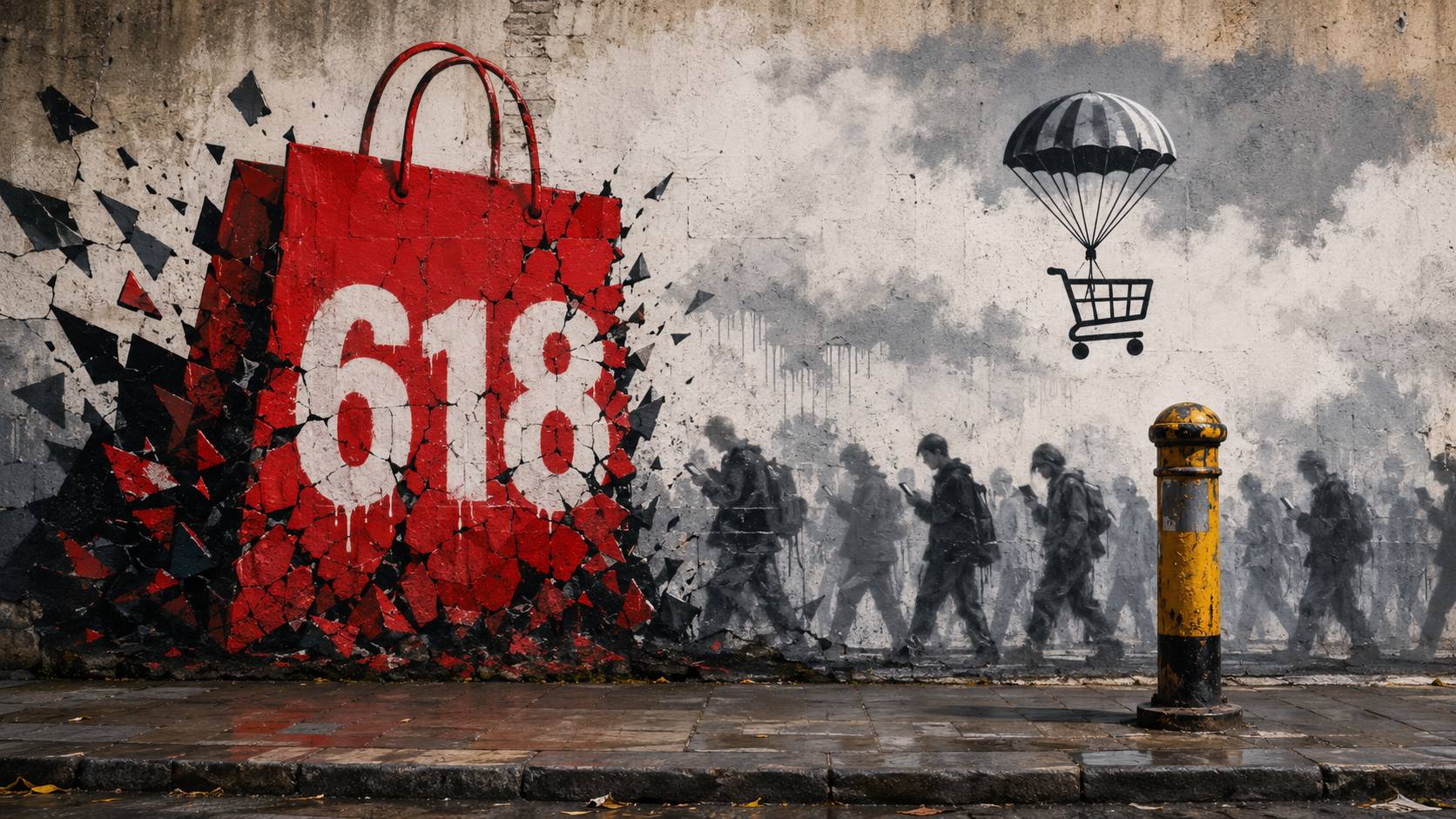
If you wanted one sentence to explain the new mood of Chinese e-commerce it might be this: discounts are no longer an event. They are the weather. The annual 618 shopping festival, once one of the most reliable markers of China’s consumer appetite, has become something more complicated - still huge, still commercially important but no longer capable of generating excitement simply by existing. That matters far beyond a single promotion. It suggests one of the foundational assumptions of the platform era may be breaking down: that if you keep lowering prices and increasing promotional intensity, consumers will keep responding with the same enthusiasm.
The Festival That Lost Its Urgency
For years 618 looked like proof that China’s digital-retail machine could always find another gear. What began as JD.com’s June 18 anniversary evolved into a national mid-year shopping season embraced by Alibaba, Pinduoduo, Douyin and nearly every major consumer brand. Total estimated GMV across major platforms rose from RMB 578.5 billion in 2021 to RMB 798.7 billion in 2023, according to Syntun. The event seemed unstoppable. Then 2024 arrived and 618 posted its first meaningful setback in years: GMV fell 7% to RMB 742.8 billion. In 2025 the headline number bounced back sharply reaching RMB 855.6 billion. But even that “recovery” came with a warning sign. Reuters reported that average daily spending still fell, dropping to RMB 23.1 billion from RMB 24.8 billion the year before, because the promotion had stretched over a longer period. The total got bigger; the urgency got weaker.
That distinction is the heart of the matter. 618 is not dying because nobody buys during 618. It is changing because consumers are no longer behaving as if the festival is the only moment that matters. The old logic of scarcity - wait for the big sale, load up, grab the once-a-year deal - makes less sense in a market where the largest platforms run permanent subsidy channels, livestream deals, category coupons, member discounts and platform-funded price cuts almost every week. The festival has been diluted by its own success. As one shopper put it in reporting on the 2024 event: “The platforms are always doing promotions.” Reuters also quoted a brand operator saying Chinese e-commerce had become “Everest commerce” with giant retail peaks that may now be getting less pointy as promotional periods lengthen and consumers lose interest in waiting for a big reveal.
Consumers Are Becoming More Selective
This is not just a story about marketing fatigue. It is also a story about macroeconomics. Chinese consumers have been living through a prolonged property slowdown, soft wage expectations, cautious hiring conditions and high sensitivity to value. McKinsey described the market in 2025 as a “new reality” defined by single-digit growth and widespread trading down. Bain and Worldpanel found that 2024 FMCG value growth in mainland China was only 0.8%, supported by volume growth but dragged down by a 3.4% decline in average selling prices. Kantar saw the same behavioral pattern: consumers were buying more carefully, trading down and rewarding value rather than spectacle. In that environment a platform can still create traffic but traffic alone does not guarantee emotionally driven spending.
Alibaba’s Shift From Discounts to Experience
That is why the most interesting thing about recent 618 cycles is not how much platforms discounted but how they changed the way they talked about discounting. Alibaba’s 2024 campaign is a good example. Taobao and Tmall removed presales, simplified the rules, offered more than RMB 15 billion of vouchers and paired that with a record RMB 200 billion rapid-settlement program for merchants. The company was still investing heavily but it was no longer pretending complexity itself was a feature. In 2025 Alibaba highlighted that 453 brands surpassed RMB 100 million in GMV and that buyer growth reached double digits. By fiscal 2026 management was talking even more about loyalty, user experience, AI and quick commerce. Its 88VIP membership base passed 62 million. Qwen was integrated into the full Taobao catalog. Those are not the signals of a company that believes the future of commerce is one more coupon stack. They are the signals of a company trying to make shopping frictionless enough that discounts become one input, not the whole strategy.
JD’s Ecosystem Expansion
JD has moved in a similar direction though from a different starting point. It still leans on its strengths in branded retail, logistics and trust but JD’s own disclosures now describe 618 less as a pure transaction event and more as a total ecosystem activation. In 2025 the company said purchasing users more than doubled year on year and order volume surpassed 2.2 billion across online, offline and food-delivery businesses. In the first quarter of 2026 JD said annual active customers reached a new record. Yet its marketing expenses have risen sharply: full-year 2025 marketing expense climbed to RMB 84.0 billion from RMB 48.0 billion in 2024 and Q1 2026 marketing expense rose another 45.8% year on year. That sounds contradictory until you realize the company is spending not just to “win 618” but to build adjacent habits in food delivery, local services and higher-frequency commerce.

Pinduoduo and the Limits of Permanent Subsidies
And then there is Pinduoduo, the platform that arguably changed the ground rules for everyone else. PDD’s subsidy architecture made low-price, always-on shopping mainstream in China. Once “百亿补贴” stopped being a campaign and became a standing proposition the entire market had to adapt. PDD’s management now frames the next phase not as more subsidy theater but as ecosystem health and supply-chain investment. In 2025 it said larger merchant-support investments would weigh on short-term profitability. In 2026 it called supply-chain investment its “core strategic priority.” That is a profound pivot. The company that helped train consumers to expect permanent low prices is now admitting that permanent low prices alone are not enough. Someone still has to build a healthier platform under the price layer.
Douyin and the Rise of Ambient Shopping
Douyin complicates the picture even further because it has changed how demand is created in the first place. In shelf-commerce consumers may wait for festivals. In content-commerce, they often discover and buy within the same flow. Kantar reported that Douyin had already become the second-largest online FMCG platform in China in Q1 2024, ahead of JD, with 18% share. Analysys estimated its live-commerce share at 37.3% in Q2 2024. Douyin’s public merchant-support messaging now focuses on reducing operating costs, improving traffic efficiency and helping merchants convert continuously rather than just through one giant seasonal spike. That is exactly what you would expect in a market where the line between entertainment and retail has become porous. If 618 was designed for the age of search-led e-commerce Douyin is designing for the age of ambient shopping.
Regulators Are Pushing Back Against Discount Chaos
The most revealing evidence that the market is rebalancing came in 2026. Reuters reported that 618 was drawing to a subdued close with only modest single-digit growth expected and described pressure from regulators for platforms to disengage from excessive discounting. That phrase matters. China’s regulators are not banning promotions. They are signaling that “cutthroat competition", fake discounts, predatory pricing and coerced participation in subsidy campaigns are no longer acceptable collateral damage in the race for share. The atmosphere is turning against discount chaos. For brands and merchants, that could be good news. A market built on permanent markdowns usually ends by destroying trust: consumers stop believing in stated savings, merchants stop believing the economics are worth it and premium brands start worrying about long-term price perception.

What Brands Should Do Next
So what should brands do if consumers really are exhausted by permanent sales?
First, stop assuming that the biggest discount wins. When promotions become constant clarity matters more than drama. The 2024 simplification of 618 mechanics - fewer presales, cleaner pricing, direct discounts - was widely read as a positive response to consumer frustration. Brands should take that lesson seriously. If your savings message needs a spreadsheet you have already lost attention.
Second, make 618 solve a concrete demand problem. The strongest performers in recent cycles were not random markdown stories; they were brands aligned with real purchase logic. Apple’s retailers cut iPhone prices by as much as RMB 2,530 ahead of 618 in 2025 to defend market share in a tougher smartphone environment. Tmall said brands such as Apple, Xiaomi, Huawei, Nike, Adidas, L’Oréal and Lululemon exceeded RMB 1 billion in GMV during 2025 6.18. Those were not “festival-only” brands. They were brands with strong recognition, clear category-fit and enough relevance to turn a discount into a conversion trigger rather than a desperation signal.
Third, invest in retention and membership, not just campaign spend. Alibaba’s 88VIP base surpassing 62 million is not a side note; it is evidence that premium consumers respond to accumulated value not just event-by-event discounts. Brands that use 618 to acquire customers without a post-festival retention plan will increasingly discover that they have rented attention at high cost and gained little loyalty in return.
Fourth, think cross-channel and content-first. The future of 618 is unlikely to be won purely on shelf placement. It will be won by tying product stories to discovery, creator trust, short video, livestream conversion and local fulfillment. That does not mean every brand needs to become a media company. It does mean the old separation between media budget and trade budget is collapsing. Douyin, Taobao livestreaming, JD local services and content-platform partnerships are all moving the same way: commerce works best when brands can collapse the path from inspiration to checkout.
Finally, treat 618 as a test of operating discipline. In the next phase of China retail the most valuable brands will not be the ones that discount hardest. They will be the ones that know exactly which customers they are trying to convert, what price architecture preserves trust, which products deserve support and which promotions simply pull demand forward and destroy margin. The companies themselves have already started to learn that lesson. Alibaba is talking about unit economics and AI. JD is trying to turn a shopping event into a broader service ecosystem. PDD is reinvesting in merchants and supply chains. Douyin is helping merchants lower operating costs. The platforms are telling us, in their own way, that the era of pure discount theater is ending.
Promotions Are Becoming Infrastructure
That is why “the death of the discount festival” is the right phrase - not because discounts are disappearing but because discounts have lost their ability to be the entire story. China’s 618 still matters. It may still produce eye-catching totals. It will still be full of deals. But the old belief that permanent sales can permanently stimulate demand now looks exhausted. Consumers have adapted. Merchants have adapted. Regulators have adapted. Platforms are adapting. The next phase belongs to the players who understand that promotions are no longer magic. They are infrastructure. And infrastructure only matters if the economics underneath it work.