From Counterculture to Cart Culture
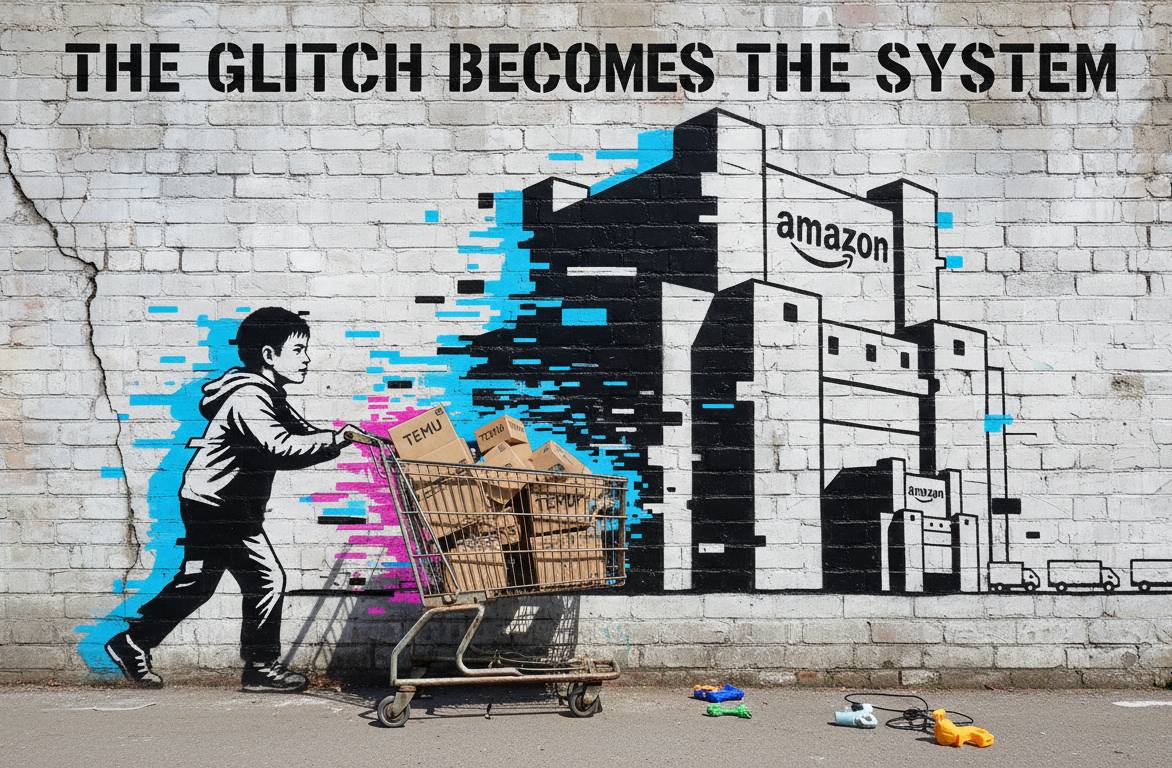
For a while Temu looked like the cleanest possible rebuke to the Amazon model. No Prime moat. No giant American fulfillment empire. No decades-long seller bureaucracy. No warehouse-heavy cost base that had to be amortized across a mature retail machine. Instead Temu arrived in the United States like a glitch in global commerce: factories and merchants in China, unbelievably cheap goods, direct-to-consumer parcels, almost no friction for the buyer and far less visible infrastructure than the incumbents. It felt like e-commerce after Amazon. It turns out it may have been e-commerce on the road back to Amazon.
The irony is almost too neat. Amazon spent 2024 and 2025 reacting to Temu’s rise with Amazon Haul, a lower-cost storefront built to compete with bargain marketplaces. At the same time Temu spent those same months borrowing the bones of Amazon’s own playbook: recruit third-party sellers, move inventory closer to the customer, integrate with fulfillment software, make returns feel familiar and turn the platform into a logistics-and-traffic layer rather than just a parcel pipeline from China.
So yes, Amazon copied Temu a little. But Temu, much more consequentially, started copying Amazon a lot.
How Temu discovered the laws of American retail
To understand why this matters it helps to remember what Temu originally was. In January 2024 AP and Marketplace Pulse still described Temu as a marketplace dominated by China-based sellers — more than 100,000 of them by the estimates cited then. Marketplace Pulse’s key point was that Temu was not simply “Amazon with cheaper prices.” It was much more controlled. Sellers shipped in bulk to Temu warehouses in China; Temu handled pricing, marketing, fulfillment and customer service. That is not a classic third-party marketplace. That is a highly managed machine for turning Chinese manufacturing into low-friction Western consumption.
Then the structure began to bend. In early 2024 Temu confirmed that it was opening to U.S. and European sellers. Reuters reported that the company said it wanted sellers in those markets in order to reduce shipping distances and delivery times. That sounds modest enough but it was the first clear sign that Temu had recognized a fundamental truth: if you want to stop being merely a cross-border arbitrage app and start becoming lasting retail infrastructure you have to do three things. You need a domestic seller story. You need domestic inventory. And you need domestic trust. Amazon built its empire on exactly that trio.
By the second half of 2024 the shift was no longer theoretical. Reuters later reported that Temu had been moving more goods by sea in bulk and sending more products into U.S. warehouses before sale. Two China-based Temu sellers told Reuters that by the end of 2024 half the products they sold to U.S. customers were first going to warehouses in America. Marketplace Pulse estimated that about 20% of Temu’s U.S. sales were already being shipped by local sellers within months of the spring 2024 recruitment push. If the old model was “factory in China to front door in America” the new one was increasingly “factory in China to container to U.S. warehouse to domestic parcel network”.
That is not post-Amazon. That is Amazon logic with Chinese manufacturing underneath it.

Temu stops acting like a hack
Temu also started acting like a seller platform in a much more recognizable way. The company’s public U.S. seller page now looks less like a curiosity and more like a familiar marketplace funnel. Create an account in a minute. Finish an application in ten. Get an answer in a day. Registration is free. There is a seller academy. There are modules for products, orders, logistics and returns and ads. Temu even says that, by its internal data, 50% of new merchants make their first sale within 20 days. It is hard to overstate how different that is from the company’s original outsider mythology. Temu is no longer merely saying “come shop cheap.” It is saying “come build a business here.”
The hiring tells the same story with less marketing polish. In 2025 Business Insider reported that Temu had been pulling people from Amazon, Walmart and TikTok to build a U.S. seller base. Its own LinkedIn-posted job descriptions are revealingly unromantic. One U.S. business-development role is about developing relationships with manufacturers, brands and merchandise partners and then helping them think through product planning, brand marketing and operations. Another role in seller enablement is explicitly about onboarding, compliance and operational support. That is not the language of a company drunk on virality. It is the language of a company building a marketplace bureaucracy. Which is another way of saying: it is growing up into Amazon’s shape.
The clearest public break came in November 2024, when Temu removed the invite-only restriction for U.S. sellers. Modern Retail and PYMNTS reported that any U.S. brand or individual seller could register and Temu said sellers could ship from U.S. warehouses with some products arriving in as little as one business day. That is a tiny sentence with huge strategic consequences. One-day shipping is not just a delivery promise. It is a declaration about what kind of company you are trying to become. Temu was effectively saying: we are done being defined only by cheapness and distance. We want speed now too. Speed is Amazon’s religion.
Temu's post-de-minimis transformation
Then Washington stepped in and accelerated the plot. In April 2025 the White House said it was ending duty-free de minimis treatment for low-value imports from China and CBP said the restrictions would be fully implemented from May 2, 2025. This mattered because de minimis had been a core enabler of the Temu-era shopping experience: lots of low-value parcels, little tariff friction, limited paperwork and a shopping flow that turned global supply chains into a near-magical consumer frontend.
Temu’s response was telling. On May 2 it said that all U.S. sales were being handled by locally based sellers and fulfilled from within the country. Reuters noted that trade experts expected the company to replenish U.S. warehouses in bulk. In other words, when the customs loophole narrowed Temu did not defend the old model as sacred. It pivoted harder into the new one. This is where the transformation becomes more subtle than “Temu stops shipping from China”. That headline is too literal. Temu’s later public partner documentation still references Local and Semi seller systems which suggests the company has not abandoned hybrid fulfillment architectures. What it appears to be doing instead is moving China upstream. Rather than selling China to America one parcel at a time it is increasingly importing Chinese supply in bulk, staging it domestically and then completing the last mile inside a more conventional marketplace frame.
Amazon did something similar over years: build selection by letting others own more inventory risk while Amazon owns the customer experience. Temu is trying to compress that learning curve into quarters. The return mechanics are another tell. Temu’s U.S. return policy now reads much less like an exotic cross-border merchant and much more like a domestic retail platform. Most items can be returned within 90 days. The first return on an order is free. Later returns on the same order cost $7.99 plus tax. U.S. shoppers can use Happy Returns, FedEx, USPS or UPS locations. For local-warehouse items Temu tells shoppers to contact the seller. None of this proves Temu has built a full Amazon-style internal logistics kingdom. But it proves something nearly as important: Temu understands that if you want repeat purchasing at scale the hard part is not the discount. The hard part is the boring stuff - returns, labels, drop-off points, seller accountability and predictable domestic service.
Welcome to the most Amazonian sentence of all: the boring stuff is the strategy. Of course, becoming more Amazon-like does not automatically mean becoming more powerful. Temu’s post-de minimis adjustment came with pain. Reuters reported that Temu’s daily U.S. users fell 48% in May 2025 compared with March 2025. The same broader shift also hit the logistics system around it: Reuters cited a 39% drop in daily average freighter capacity on the China-U.S. route after May 2. That matters because Temu’s original edge was a mix of price opacity, shipping arbitrage and consumer novelty. Domestic inventory makes the service less weird and more reliable but it can also make the model less radically cheap.

The price of reliability is becoming ordinary
The anti-Amazon trade-off is disappearing. And with it some of Temu’s old magic. That might still be the correct trade. Amazon itself is proof that a marketplace can be more valuable when it becomes less exotic. Amazon’s independent sellers now account for more than 60% of sales in its store, according to the company, and FBA plus Seller Fulfilled Prime let Amazon win both flavors of the logistics argument: sellers can use Amazon’s warehouses or their own but Amazon still sits at the center of the transaction. Temu is nowhere near that depth. Its public U.S. fee structure is still less transparent; its U.S. seller footprint is still relatively opaque and its trust moat is much thinner.
But the architecture it is moving toward is recognizably the same architecture. That is why this story matters. Temu is not just becoming more local. It is becoming more platform-like in the very specific, highly monetizable Amazonian sense of the word. And that leaves us with the best line in the whole drama: the anti-Amazon is slowly becoming… Amazon. Not because Temu wants Amazon’s public image and certainly not because it wants Amazon’s cost base. But because once you try to build lasting mass-market e-commerce in America you keep stumbling into the same operational truths. Sellers need tools. Inventory needs to be nearby. Delivery needs to be faster. Returns need to feel domestic. Trust needs to be routinized.
At that point ideology gives way to logistics. Temu may have arrived as a challenge to Amazon’s model. But its next phase looks increasingly like an admission that Amazon’s core marketplace playbook - traffic on top, sellers underneath, fulfillment all around - was not a historical accident. It was the template.